


 English
  Français
  Tiếng Việt
  Italiano
  Nederlands
  Türkçe
  Svenska
  Polski
  Română
  Latviešu
  한국어
한국어  Русский
  Español
  Deutsch
  Українська
  Português
  العربية
  Indonesian
  Čeština
  Suomi
Suomi  Eesti
Eesti  Български
  Dansk
Dansk  Lietuvių
  Bokmål
  Slovenčina
  Slovenščina
  Ελληνικά
  Magyar
  עברית
עברית 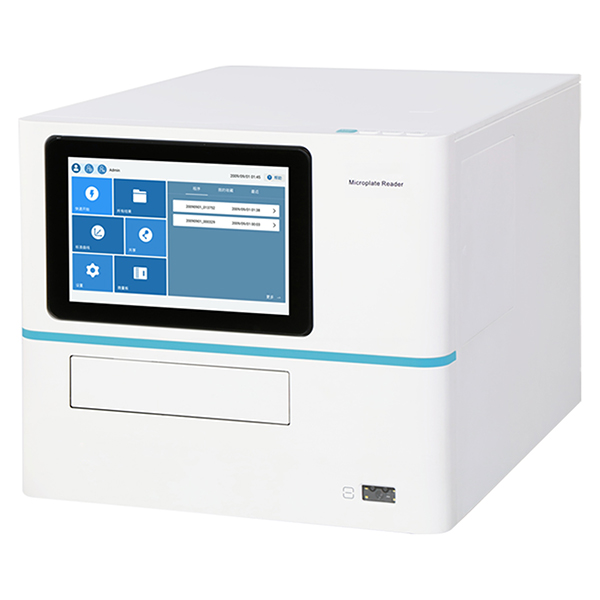
multimode microplate reader optional injection modules
Multimode microplate reader is a high-performance laboratory instrument integrating multiple detection modes, designed for the scientific research needs in the fields of biomedicine, drug discovery and development, life sciences and other fields.
Description
Multimode microplate reader has modular design, which can be flexibly upgraded and customized according to the experimental needs, providing high-quality data analysis and processing functions to enhance the experimental efficiency and reliability of results.
Main Features of Multimode Microplate Reader
- Multiple detection modes: support light absorption, fluorescence, chemiluminescence, time-resolved fluorescence (TRF), fluorescence polarization (FP) and other modes, which is suitable for a variety of detection needs.
- High sensitivity detection: Adopting advanced photomultiplier tube (PMT) technology, it can accurately detect weak signals to ensure high sensitivity and high precision.
- Modular design: provide dedicated, scalable detection accessories, convenient to configure and expand according to different experimental needs.
- Intelligent operation: full automatic gain adjustment and correction function simplifies the experimental setup without manual intervention and improves the stability and repeatability of the experiment.
- Powerful data processing functions: support a variety of data analysis methods, such as subtracting blanks, standard curve production, qualitative analysis, kinetic analysis, etc., to help users quickly get high-quality experimental results.
- Convenient data sharing and storage: built-in data sharing library, supports uploading data via QR code and FTP, convenient for result sharing and remote data viewing.
Advantages of Multimode Microplate Reader
- Flexibility and Expandability: Different detection modes can be selected according to experimental needs, and other functions can be added flexibly through modularized design to meet the needs of complex experiments.
- Precision and stability: Optimized optical design and advanced electronic control system ensure the precision and stability of the experimental results, suitable for high-throughput and micro-volume sample analysis.
- Simplified operation: no need to frequently adjust the instrument settings, intelligent automated operation greatly reduces human error, improve experimental efficiency and accuracy.
- Efficient data analysis: provide a variety of data processing and analysis methods, support for custom algorithms and real-time generation of QR code, simplify the management and sharing of data, improve the efficiency of collaboration between the team.
Working Principle
- Light Absorption Detection: The instrument adopts a monochromator optical path system, which can carry out accurate wavelength scanning in the range of 200nm to 1000nm, and the step accuracy reaches 1nm. The instrument is also equipped with a reference optical path, which ensures the stability and accuracy of the detection results. The light source, light shed, detector and other components are automatically calibrated after startup to ensure the accuracy of spectral data.
- Fluorescence detection: The optical path design based on dichroic mirrors and filters enables sensitive fluorescence detection at the top of the microplate. The independent detachable filter module allows researchers to switch between different wavelengths easily and quickly. Through the automatic gain and correction function, the instrument can automatically adjust the voltage of the photomultiplier tube (PMT) according to the signal strength of the sample, ensuring that a reliable concentration range and accurate detection results can be obtained under different experimental conditions.
- Chemiluminescence detection: This mode utilizes advanced photomultiplier tube (PMT) technology to enhance the sensitivity of weak luminescence signals and effectively avoid saturation of high signals. The optimized chemiluminescence optical path design reduces inter-well signal crosstalk and ensures the accuracy of experimental results. Precise dual-channel autosampler can maintain excellent detection performance in high-density 384-well plates.
- Time-Resolved Fluorescence (TRF): Lanthanide labeled dyes are used, after excitation, the duration of the emitted light is longer than ordinary fluorescein. After the excitation light is turned off, the emitted light is still released continuously, effectively eliminating the interference of excitation light and scattered light, thus improving the sensitivity and accuracy of detection. Time-resolved fluorescence has the characteristics of high sensitivity, high specificity, good stability, short operation process, etc. It is suitable for ultra-trace analysis in biology and medicine, hormone detection, viral hepatitis marker detection, targeted cell drug detection and drug screening.
- Fluorescence Polarization (FP): Optimized optical path design combined with fast switching polarizer function can effectively reduce the detection bias. This function is mainly used for the detection of interactions between small molecules and macromolecules, such as drug and hormone binding, tyrosine kinase detection, protein-peptide interactions and other studies.
Application Areas
- Life science and molecular biology: widely used in gene expression, protein interaction, cell proliferation, etc., to support high-throughput screening and molecular biology research.
- Medical research and clinical diagnosis: for hormone detection, viral hepatitis marker detection, cancer marker detection and other medical research, suitable for clinical diagnostic experiments.
- Drug development and screening: provide drug screening, drug-receptor binding studies, targeted cell drug detection and other functions to help new drug development.
- Environmental monitoring and food safety: suitable for water quality testing, food pollutant detection, environmental pollution detection and other research.
- Agricultural research: in the field of agriculture, it can be used for plant hormone detection, pesticide residue analysis and so on.
Data Analysis and Processing
- Subtracting Blanks: Support automatic subtraction of blanks to ensure the accuracy of detection data.
- Standard curve production: automatically generate standard curve according to the experimental data to provide accurate quantitative analysis.
- Quality control and kinetic analysis: able to perform quality control during the experiment to ensure that each experimental result is within the standard range. kinetic analysis to help researchers study the reaction rate and kinetic model.
- Algorithm customization: Support users to customize the analysis algorithm according to the experimental needs to improve the flexibility and accuracy of data processing.
Data Storage and Sharing
- Shared Library Function: Built-in shared library allows users to store and share programs, results, standard curves, etc., facilitating multi-user collaboration.
- QR code support: real-time generation of QR code, users can scan the QR code to import the required program or data, which enhances the convenience of operation.
- FTP upload function: the instrument supports uploading data to FTP server, which is convenient for remote access and data backup.
User Rights Management
- Four-level rights management: rights are assigned according to the user’s role, ensuring that different users can only access the corresponding functions and data, guaranteeing the security and confidentiality of data.
- Independent account settings: each user has an independent account and password to ensure the security of experimental data.
Technical Parameters
| Model | MR30-1 | MR30-2 | MR30-3 |
|---|---|---|---|
| Absorption, Fluorescence, Chemiluminescence | yes | ||
| Time-Resolved Fluorescence | no | yes | yes |
| Fluorescence Polarization | no | no | yes |
| Absorption of light, Grating | |||
| Light Source | xenon lamp | ||
| Detector | PD | ||
| Wavelength Accuracy | 2nm | ||
| Wavelength Repeatability, SD | 0.2nm | ||
| Full Width at Half Maximum | less than 2.5nm | ||
| Wavelength Range | 200nm to 1000nm, 1nm increment | ||
| Measurement Range | 0 to 4 OD | ||
| Resolution | 0.0001 OD | ||
| Accuracy at 450nm | 96-Precision Mode: ±(1.0% + 0.003 Abs) for (0.0 to 2.0 Abs], ±2.0% for (2.0 to 3.0 Abs] | ||
| Repeatability at 450nm | CV < 1.0% or SD < 0.003 in Fast mode (0.0 to 3.0 Abs], CV < 0.5% or SD < 0.003 in Precision mode (0.0 to 3.0 Abs] | ||
| Stray Light | 0.1% at 220nm | ||
| Linearity at 450nm | ≥0.999 at [0.0-3.0Abs] | ||
| Reading Time | 96 microplate, less than 15 seconds | ||
| Fluorescence, optical filter | |||
| Reading Mode | top reading | ||
| Excitation Light Source | xenon lamp | ||
| Detector | PMT | ||
| Wavelength Range | EX: 200nm to 1000nm, EM: 270nm to 850nm | ||
| Filter | 3 sets, EX485|EM530, EX523|EM564, EX624|EM692, other wavelengths customizable | ||
| Limit of Detection | 1pm | ||
| Linear Dynamic Range | 6 logs | ||
| Chemiluminescence | |||
| Detector | PMT | ||
| Limit of Detection | 15 amol, well, 5 amol, well, with photomultiplier tube, PMT | ||
| Linear Dynamic Range | 6 logs | ||
| Crosstalk | ≤0.005% | ||
| Wavelength Range | 200nm to 850nm | ||
| Time-Resolved Fluorescence | |||
| Wavelength Range | EX: 200nm to 1000nm, EM: 270nm to 850nm | ||
| Limit of Detection | 0.02pm | ||
| Fluorescence Polarization, Optical Filter | |||
| Wavelength Range | 300nm to 850nm | ||
| Limit of Detection | 5mp | ||