


 English
  Français
  Tiếng Việt
  Italiano
  Nederlands
  Türkçe
  Svenska
  Polski
  Română
  Latviešu
  한국어
한국어  Русский
  Español
  Deutsch
  Українська
  Português
  العربية
  Indonesian
  Čeština
  Suomi
Suomi  Eesti
Eesti  Български
  Dansk
Dansk  Lietuvių
  Bokmål
  Slovenčina
  Slovenščina
  Ελληνικά
  Magyar
  עברית
עברית 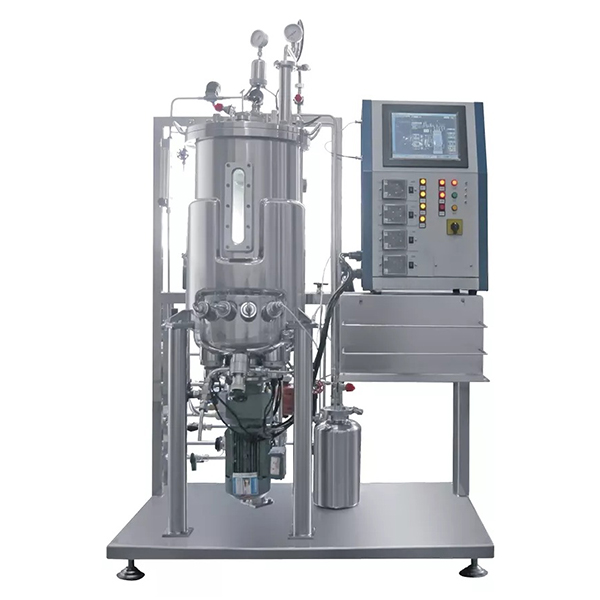
stainless steel photobioreactor for photosynthesizing biocultures
Stainless steel photobioreactor is suitable for high-density cultivation of photosynthesizing cells and microalgae, which is widely used in many fields such as microbial cultivation, pharmaceutical production and environmental treatment.
Description
Stainless Steel Photobioreactor
Features
- Light control: the use of embedded or external cover light source, with efficient light effect. The wavelength, color and light intensity of the light source can be customized to meet the needs of different types of cell culture.
- Accurate parameter control: temperature, speed, pH, DO, defoaming, replenishment and many other key parameters can be monitored online and automatically controlled to ensure the stability of the culture process. The reactor realizes high-precision control through PID control system to ensure that each stage of culture is in good condition.
- Stirring system: top mechanical stirring or magnetic coupling stirring is adopted, which can provide uniform stirring and promote the transfer of oxygen and nutrients. The stirring speed ranges from 50rpm to 1000rpm ±5%, adapting to different cell culture needs.
- Material and structure: The reactor adopts the combination of high temperature and corrosion resistant silicon boron glass tank body and 316L stainless steel tank cover, which has high corrosion resistance and light transmission, and at the same time, it is easy to observe the reaction process. The inner and outer surfaces of the reactor are mirror polished with high precision to ensure the cleanliness and light transmission rate, which is suitable for light culture.
- Multiple control systems: with automatic control of temperature, pH, DO, stirring, replenishment and other functions, and support the integration with other external systems. Real-time data collection and report generation make the operation more convenient and precise.
Working Principle
- Light Action: the core principle of the photobioreactor is to use light to promote the growth of photosynthetic cells, microalgae, algae and other photosynthetic microorganisms. Through the customized light source system, the wavelength and intensity of light are adjusted according to the needs of the cultured cells, so as to improve the photosynthetic efficiency.
- Mass transfer mechanism: Top mechanical stirring and magnetic coupling stirring system are adopted, which makes the gas-liquid mixing inside the reactor more uniform and improves the oxygen transfer efficiency. The reactor realizes precise control of flow, temperature, pH and other parameters through the intelligent PID control system, thus providing a suitable culture environment.
- Defoaming and replenishment control: the reactor is equipped with an automatic defoaming system and a precise replenishment system. Controlled by peristaltic pump, it can automatically add antifoam or replenishment according to the change of foam and nutrient demand during the cultivation process, avoiding the effect of air bubbles on cells.
Application Areas
- Microalgae culture: photobioreactor is widely used in microalgae culture, suitable for high-density and high-activity microalgae culture. Through customized light source, it provides enough light to promote the rapid growth of microalgae.
- Photosynthesis cell culture: It is suitable for the efficient culture of various photosynthesizing microorganisms, algae, etc. for the production of biofuel and nutrients.
- Biomedical production: In the pharmaceutical industry, photobioreactors can be used for cell culture and gene expression. For example, it has important applications in the cultivation of cellular drugs, vaccines and so on.
- Environmental protection field: used for algae culture in wastewater treatment, through the photosynthetic process, to reduce the pollution of the water body, the use of microalgae to absorb harmful substances in the water.
- Agriculture and food industry: used in the production of high value-added food components, additives and so on. For example, microalgae production of Omega-3 fatty acids, antioxidants and so on.
- Control system: Intelligent control: the system is equipped with an 11-inch touch screen, users can intuitively view all kinds of parameters, including temperature, pH, DO, stirring rate, etc., and can be remotely monitored and controlled.
- Data recording and management: support data storage, historical curve display, report generation, and in line with FDA 21 CFR Part 11 regulations, with electronic records and electronic signature function.
- Recipe management and remote control: support the management and remote control of multiple fermentation recipes, users can adjust and monitor the parameters through cell phone APP.