


 English
  Français
  Tiếng Việt
  Italiano
  Nederlands
  Türkçe
  Svenska
  Polski
  Română
  Latviešu
  한국어
한국어  Русский
  Español
  Deutsch
  Українська
  Português
  العربية
  Indonesian
  Čeština
  Suomi
Suomi  Eesti
Eesti  Български
  Dansk
Dansk  Lietuvių
  Bokmål
  Slovenčina
  Slovenščina
  Ελληνικά
  Magyar
  עברית
עברית 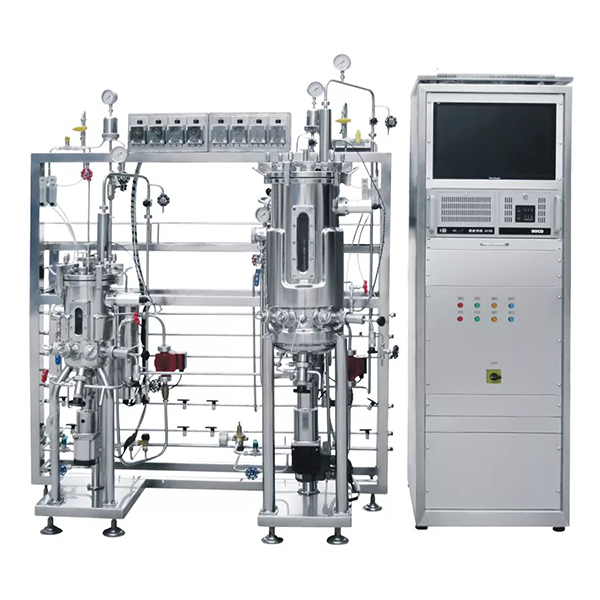
airlift stainless steel fermenter with in situ sterilization
Airlift stainless steel fermenter with in situ sterilization is a non-mechanical stirring fermentation system based on gas circulation drive, combining aseptic operation, automation control, high-strength structure and gentle cultivation environment in one.
Description
Airlift Stainless Steel Fermenter with In Situ Sterilization Overview
Airlift stainless steel fermenter with in situ sterilization is made of 316L stainless steel, supports in-line CIP cleaning and SIP sterilization, suitable for microorganisms or cell cultures that are sensitive to shear, widely used in the fields of biopharmaceuticals, food fermentation, agricultural microbiology, and environmental protection engineering.
The conventional capacity of airlift stainless steel fermenter with in situ sterilization covers from 10L to 100L, which is suitable for fermentation process requiring continuity of sterilization and high degree of automation, from process development to pilot test and validation stage.
Main Features
- The material is preferred, in line with GMP requirements: the whole adopts 316L stainless steel liner, the inner surface is mirror polished, and the outer surface is matte treated, with excellent corrosion resistance and cleanliness, to meet the pharmaceutical grade sterile production environment.
- Airflow mixing, low shear: the use of bottom aeration to form a gas-liquid two-phase flow, the built-in guide tube under the action of the culture liquid to promote the rise, to achieve the natural circulation of fluids. Avoiding the high shear produced by traditional mixing, it protects the microorganism form and activity, and is suitable for sensitive systems such as filamentous bacteria, actinomycetes and plant cells.
- Online automatic sterilization function: support in situ steam sterilization SIP and online cleaning CIP, the entire sterilization and cleaning process can be programmed and controlled without disassembly, to ensure the continuity of the fermentation process and the safety of the operation of the aseptic.
- Rational structural design: tank height to diameter ratio of 1:6 to 1:8, with a central deflector inside to enhance liquid convection and oxygen transfer efficiency. The top of the tank is equipped with a standard inlet, which can be connected to pH, DO, conductivity and other electrodes as well as replenishment, inoculation, sampling and other functional modules.
- High-efficiency gas mixing system: Equipped with microporous aerator, oil-free air compressor and air sterilization and filtration system to ensure clean gas and significantly improve the oxygen utilization rate.
- Automation control system: equipped with multi-channel PLC control system, supporting real-time monitoring and closed-loop control of temperature, gas flow, pH, DO, replenishment, tank pressure and other parameters, can be docked with SCADA system to realize remote operation and data tracking.
Working Principle
- Gas-lift fermenter introduces air or mixed gas through the bottom to form a continuous bubble upflow inside the liquid. This gas drives the fermentation liquid to rise through the guide cylinder, and then naturally sinks when it reaches the top, thus forming a stable liquid circulation loop inside the tank. This process not only promotes the homogeneous mixing of the liquid, but also improves the solubility of oxygen in the liquid, and enhances the mass transfer efficiency.
- Because there is no mechanical stirring parts, the system will not produce high intensity shear stress during operation, to protect the cell structure, suitable for fermentation of complex morphology or fragile structure of the biological system.
- In addition, the supporting online sterilization system can be used to heat the tank and pipeline through steam to kill stray bacteria, to ensure that the entire culture process is always in a sterile state.
Applications
- Antibiotics and active metabolites production: such as penicillin, erythromycin and other products that require large-scale cultivation of actinomycetes or filamentous fungi, which are suitable for air-lift fermentation process with low shear and uniform mixing.
- Plant cell and fungus culture: suitable for secondary metabolites, such as paclitaxel, camptothecin, ginseng saponin and other high-quality culture and fermentation amplification.
- Microalgae industrialized culture: suitable for the fermentation of shear-sensitive algae, such as red algae, spirulina, alginate-producing bacteria, etc., to ensure the integrity of the cell structure and improve the yield.
- Agricultural microbial preparation production: it can be used for the production of Bacillus subtilis, Bacillus licheniformis, Bacillus amyloliquefaciens and other beneficial strains for soil improvement and disease prevention and control.
- Food and enzyme fermentation: such as lactic acid bacteria, yeast, enzyme bacteria and other low-stress fermentation process, suitable for the production of food additives and biological enzyme preparations with high requirements for the maintenance of biological activity.
- The field of environmental protection engineering: in the sludge treatment, anaerobic fermentation or other environmental engineering microbial expansion process, the gas lift system because of its energy saving and low-maintenance features are also widely used.