


 English
  Français
  Tiếng Việt
  Italiano
  Nederlands
  Türkçe
  Svenska
  Polski
  Română
  Latviešu
  한국어
한국어  Русский
  Español
  Deutsch
  Українська
  Português
  العربية
  Indonesian
  Čeština
  Suomi
Suomi  Eesti
Eesti  Български
  Dansk
Dansk  Lietuvių
  Bokmål
  Slovenčina
  Slovenščina
  Ελληνικά
  Magyar
  עברית
עברית 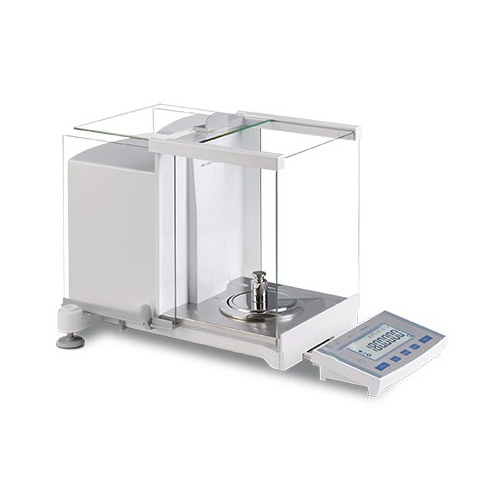
analytical balance with fully automatic internal calibration
By integrating advanced electromagnetic force sensors and a fully automatic calibration system, the analytical balance provides users with measurement accuracy and ease of operation.
Description
Whether it is used for accurate weighing of minute quantities of substances or for weight determination of routine samples, analytical balances can meet the requirements of high accuracy and stability.
Main Features of the Analytical Balance
- high graduation value: with 0.01mg or 0.1mg graduation value, it can accurately measure the weight of tiny samples, which is suitable for scientific research and industrial applications requiring high precision.
- Rear-mounted electromagnetic force sensor: adopts the classic rear-mounted electromagnetic force sensor to ensure the accuracy and stability of the weighing results, and also has the ability of fast response to adapt to the weighing needs in different environments.
- Split design: The display unit is separated from the weighing unit to avoid the vibration effect on the balance during key operation. Split design allows the user to monitor the measurement process from multiple angles, enhancing the comfort and visibility of operation.
- optimized micro-sampling function: digital signal processing technology, while maintaining the stability of the balance readings, improve the response speed of micro-sampling, suitable for powder and liquid samples of accurate sampling.
- stretchable LCD display: equipped with adjustable angle LCD liquid crystal display, the screen is clear and bright, the layout is reasonable, to ensure that the user can clearly read the weighing results at different angles.
- Transparent glass windshield: the windshield adopts transparent design to ensure that the samples are visible during the weighing process, and can be disassembled and cleaned to keep the equipment clean and in good working condition.
- a variety of weighing modes: support basic weighing, percentage weighing and counting weighing modes to meet different experimental requirements.
- a variety of weighing unit conversion: support grams (g), carat (Ct), ounces (oz), pounds (lb) and other commonly used units of weighing between the free switch, improve the versatility of the device.
- built-in RS232 communication interface: support for connection with a computer or micro-printer, to achieve the transmission and storage of weighing data, to facilitate subsequent data management and analysis.
- full-automatic calibration function: built-in temperature change sensing and timing calibration system, when the temperature changes 1.5 °C or more than 2 hours from the last calibration time, the balance starts the calibration function by itself, avoiding the potential factors of inaccuracy of the untimed calibration or external weights, so as to make the user’s weighing results more accurate and reliable, and to reduce the unnecessary operation, only for internal calibration type balance.
Advantages of Analytical Balance
- High Precision Weighing: With a resolution of 0.01mg or 0.1mg, this analytical balance is suitable for precision weighing applications for tasks requiring high weighing accuracy in scientific research, pharmaceuticals, chemical analysis and other fields.
- Automatic Calibration: The fully automatic calibration function makes the device always maintain accuracy, reducing errors caused by human factors, and reducing the trouble of frequent manual calibration.
- stability and responsiveness: the rear electromagnetic force sensor and optimized micro-sampling technology ensures stability and fast response to meet the needs of different weighing environments.
- flexible weighing mode and unit switching: support a variety of weighing modes and unit conversion, to adapt to different experimental needs, improve the operational flexibility.
- convenient data management: built-in RS232 interface and USB communication function, can be easily connected with computers, printers and other external devices to meet the laboratory data management and output requirements
- durable and easy to clean: transparent windshield design and removable structure makes the equipment more easy to clean and maintain, to ensure that the equipment for long-term stable operation.
Working Principle
- The working principle of analytical balance is based on electromagnetic force balance and high precision sensor technology. When the sample is placed on the weighing pan of the balance, the electromagnetic sensor measures the mass of the sample and balances it with the reference mass through the feedback system.
- Electromagnetic Sensor Feedback: The electromagnetic sensor ensures that small changes in the weighing process can be responded to quickly by applying an electromagnetic force that matches the sample mass.
- automatic calibration mechanism: the balance built-in temperature change sensor, regular temperature fluctuations in accordance with the automatic calibration, to ensure stability after a long period of use.
- micro-sampling support: digital signal processing technology enables the balance to efficiently identify small mass changes, suitable for powder, liquid and other samples of micro-sampling operations.
- Multi-mode operation: Through the built-in processor, the balance can automatically switch to different weighing modes, such as percentage weighing, counting weighing, etc., according to the user’s needs.
Application Areas
- Scientific research experiments: in the research of chemistry, physics, biology and other disciplines, precise weighing is essential for the accuracy of experiments.
- Pharmaceutical industry: Used for raw material proportioning, drug composition analysis and quality control to ensure product stability and compliance.
- Chemical and Material Science: In chemical reactions, accurate weighing is the basis for successful experiments, analytical balances are widely used for quality testing of raw materials and products.
- Food Industry: Used to analyze food ingredients, ingredient ratios and moisture content to ensure quality control of food products.
- Quality control and production monitoring: in the production process of key quality control links, accurate weighing to help ensure product consistency and reliability.
- Education and Training: Used for experimental teaching in colleges and universities and vocational and technical training to help students understand the operating principles of precision instruments.
Norms, Laws, Industry Standards
- GB/T26497-2022: This is China’s national standard on electronic balances, which specifies the technical requirements, performance requirements, and inspection methods of electronic balances to ensure that the equipment complies with domestic industry standards.
- OIML R76-2(2007E): This is the international recommendation on non-automatic weighing equipment issued by the International Organization for Legal Metrology (OIML), which applies to the international certification and specification of electronic balances. It ensures that the equipment meets the technical standards of the global market.
- EU Standard for Non-Automatic Weighing Instruments: This standard covers the technical requirements that must be met by non-automatic weighing instruments, such as electronic balances, sold in the EU market to ensure the accuracy and safety of their measurements.
Technical Parameters
| Model | B10A | B10B | B11A | B11B | B12A | B12B |
|---|---|---|---|---|---|---|
| Capacity | 82g, 120g | 120g | 82g, 210g | |||
| Readability | 0.01mg, 0.1mg | 0.01mg | 0.01mg, 0.1mg | |||
| Repeatability | ±0.02mg, ±0.1mg | ±0.02mg | ±0.02mg, ±0.1mg | |||
| Linearity | ±0.02mg, ±0.1mg | ±0.02mg | ±0.02mg, ±0.1mg | |||
| Calibration Method | Internal | External | Internal | External | Internal | External |
| Typical Stabilization Time | ≤2.5 seconds | |||||
| Weighing Pan Size | diameter 90mm | |||||
| Weighing Chamber Height | 230mm | |||||
| Baud Rate | 300, 600, 1200, 2400, 4800, 9600 | |||||
| External Dimensions | 470mmx310mmx320mm | |||||
| Power Supply | input: 220Vac, 50Hz, output: 12Vdc, 2A | |||||
| Note | Internal means Fully Automatic Internal Calibration, External means External Weight Calibration |
|||||