


 English
  Français
  Tiếng Việt
  Italiano
  Nederlands
  Türkçe
  Svenska
  Polski
  Română
  Latviešu
  한국어
한국어  Русский
  Español
  Deutsch
  Українська
  Português
  العربية
  Indonesian
  Čeština
  Suomi
Suomi  Eesti
Eesti  Български
  Dansk
Dansk  Lietuvių
  Bokmål
  Slovenčina
  Slovenščina
  Ελληνικά
  Magyar
  עברית
עברית 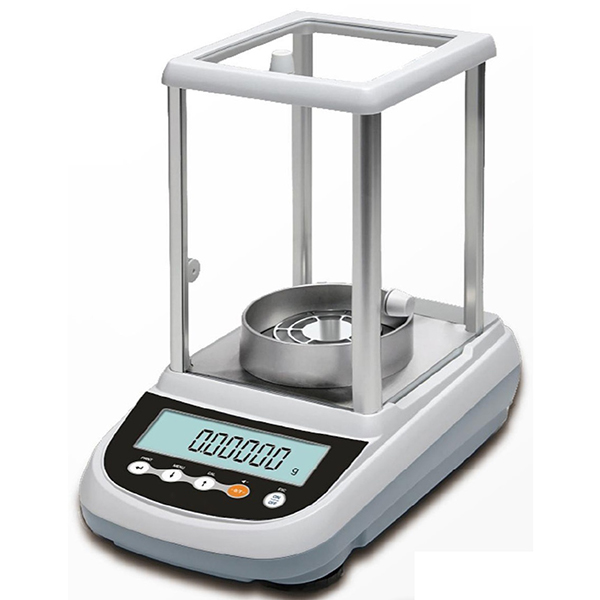
analytical balance with optional static eliminator
Analytical balance is a high-precision weighing equipment designed for micro-weighing tasks in scientific research, pharmaceutical, chemical, food and other laboratory and industrial environments.
Description
Analytical balances are equipped with advanced electromagnetic sensors and fully automated calibration systems to ensure high accuracy, stability and repeatability for precise quality control and analysis of samples. The wide range of application scenarios of analytical balances include weighing of powders, particles and liquids as well as a variety of unit conversions and statistical analyses, which can efficiently meet the various needs of laboratories.
Main Features of Analytical Balance
- high precision graduations: with 0.01mg or 0.1mg graduations, it can accurately measure the mass of tiny objects, suitable for scientific research and industrial applications requiring high precision.
- highly integrated electromagnetic sensor: built-in highly integrated electromagnetic force sensor, to ensure the accuracy and stability of the weighing results, and rapid response to adapt to the rapid addition of samples operation.
- Automatic internal calibration: Equipped with automatic timing calibration system, automatically calibrated according to environmental changes, to ensure the accuracy of each weighing and reduce human error.
- Multi-functional application modes: support common counting, percentage weighing, animal weighing, density determination and other weighing modes, which can meet different experimental needs.
- unit conversion function: support free conversion between units, including grams (g), milligrams (mg), carats (ct), ounces (oz), etc., flexible to adapt to a variety of experimental needs.
- formula database: built-in 99 formula storage function, convenient for quantitative weighing and formula management.
- Records and data management: conforms to the GLP and ISO format weight record keeping, including date, time and serial number and other information, convenient for quality traceability and report generation.
- Multi-language support: Support English, German, French, Italian, Spanish, Portuguese and other languages, convenient for users in different countries and regions.
- safety design: equipped with overload alarm, fault alarm and level indicator, to ensure that the equipment in the normal operating range, to avoid damage or disallowed due to misuse or changes in the external environment.
- Keyboard protection: equipped with plastic protective film, effectively prevent stains or damage, prolong the service life of the equipment.
Product Advantages
- High accuracy and stability: 0.01mg indexing value and highly integrated electromagnetic sensor ensure high accuracy and repeatability of weighing results, suitable for micro weighing tasks.
- Fully automatic calibration system: The automatic timed calibration system ensures the balance remains accurate after a long period of time, eliminating the need for frequent manual calibration and improving work efficiency.
- Multi-functional operation: In addition to basic weighing, the balance also supports counting, percentage weighing, animal weighing, density determination and other functions to meet different experimental needs.
- formula storage and management: built-in formula database, convenient for operators to save commonly used formulas and settings, reduce the complexity of the operation and improve the efficiency of the experiment.
- data traceability: the equipment complies with GLP and ISO standards, can record and save the date, time and serial number, convenient for data management and quality traceability, to meet the strict quality control requirements.
- Internationalization support: Multi-language support and unit conversion function make the equipment more widely used in the world and adapt to the needs of different regions.
- Safety Protection Function: Overload alarm, fault alarm and level indicator ensure that the balance operates in a safe working condition, avoiding accidental damage and inadmissible measurement.
Working Principle of Analytical Balance
- Electromagnetic Force Sensor Principle: When the sample is placed on the weighing pan of the balance, the built-in electromagnetic force sensor determines the weight of the sample by balancing the electromagnetic force with the mass of the sample. The sensor can respond quickly to small mass changes, ensuring high precision weighing.
- fully automatic calibration: the balance built-in fully automatic calibration function, when the ambient temperature changes over the set range or more than 2 hours from the last calibration time, the device will be automatically calibrated to ensure that the weighing results are not affected by external factors.
- data processing and storage: the balance through the digital processing technology for real-time calculation and display of weighing data. Through RS232 interface, the data can be transferred to PC or micro printer in real time, which is convenient for subsequent management and analysis.
- Multi-mode weighing: The device supports a variety of weighing modes, including counting, percentage weighing, animal weighing and density measurement, etc. Through the built-in processor, users can choose different working modes according to different application requirements.
Application Areas
- scientific research field: widely used in chemistry, biology, physics and other scientific research experiments for precision weighing, such as sample analysis, precise proportioning of chemical reactants.
- Pharmaceutical industry: Used for raw material proportioning, drug composition analysis and quality control to ensure the quality of drugs in accordance with the standard.
- Chemical and material industry: used for precise measurement of chemical substances and material formulations, supporting the weighing of different types of samples such as powder and liquid.
- Food industry: suitable for food composition analysis, moisture content determination and raw material proportioning, to ensure stable product quality.
- quality control: used for product quality control in the production process, such as raw material incoming inspection, finished product testing.
- education and training: used in laboratory teaching for precision weighing operation training, to help students understand and master the experimental operation skills.
Norms, Laws, Industry Standards
- GB/T26497-2022: China’s national standard, which specifies the technical requirements, performance standards and test methods for electronic balances, to ensure that the equipment meets the domestic industry norms.
- OIML R76-2 (2007E): international recommendations for non-automatic scales issued by the International Organization for Legal Metrology (OIML), which applies to the international certification and standards for electronic balances to ensure that the equipment meets the requirements of the international market.
- EU standard: The equipment meets the relevant technical requirements of EU non-automatic weighing equipment, ensuring that it can be sold in the EU market and comply with the relevant quality and safety standards.
Technical Parameters
| Model | B30A | B31A |
|---|---|---|
| Capacity | 62g, 120g | 82g, 220g |
| Readability | 0.01mg, 0.1mg | |
| Repeatability | ±0.03mg, ±0.1mg | ±0.05mg, ±0.1mg |
| Linearity | ±0.08mg, ±0.2mg | ±0.1mg, ±0.2mg |
| Calibration Method | Internal | Internal |
| Typical Stabilization Time | ≤6 seconds | |
| Weighing Pan Size | diameter 80mm | |
| Baud Rate | 300, 600, 1200, 2400, 4800, 9600 | |
| External Dimensions | 345mmx216mmx345mm | |
| Weight | 5.8kg | |
| Power Supply | input: 100 to 230Vac, 50Hz, output: 12Vdc, 1A | |
| Note | Internal means Fully Automatic Internal Calibration | |

static eliminator