


 English
  Français
  Tiếng Việt
  Italiano
  Nederlands
  Türkçe
  Svenska
  Polski
  Română
  Latviešu
  한국어
한국어  Русский
  Español
  Deutsch
  Українська
  Português
  العربية
  Indonesian
  Čeština
  Suomi
Suomi  Eesti
Eesti  Български
  Dansk
Dansk  Lietuvių
  Bokmål
  Slovenčina
  Slovenščina
  Ελληνικά
  Magyar
  עברית
עברית 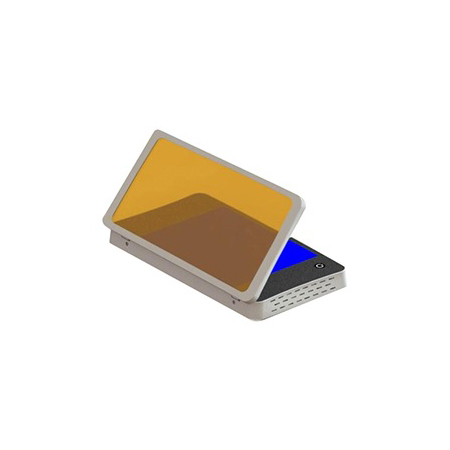
blue light transilluminator for observation of dna bands
Blue light transilluminator adopts visible blue light with suitable wavelength as excitation light source, replacing traditional ultraviolet light, with green non-toxic fluorescent dyes, realizing high sensitivity electrophoretic band observation and localization.
Description
This blue light transilluminator has a compact and portable housing, easy to operate, and is widely used in life science laboratories for electrophoretic analysis and gel cutting operations, which not only ensures the safety of the experiment, but also improves the efficiency of the experiment.
Features of Blue Light Transilluminator
- compact and portable design: adopting high-strength mold molding shell, compact size and light weight, easy to move and use between different experimental benches.
- safe and environmentally friendly light source: blue LED as the excitation light source, eliminating the health risks associated with UV radiation, while compatible with a variety of safe fluorescent dyes, eliminating the toxicity of traditional EB dyes.
- Ultra-high sensitivity: It can detect DNA as low as 0.5ng, 1000bp fragment, ensuring accurate observation of trace samples.
- durable light source life: LED lamp with up to 50,000 hours of service life, reducing the frequency of replacement, reducing the cost of use.
- the bottom of the uniform light: innovative bottom light source design, to reduce the side of the scattered light on the imaging interference, so that the strip imaging more clear and sharp.
- humanized touch control: touch sensor switch, even if you wear gloves can also be easily operated. three brightness adjustment to meet different observation needs, and equipped with an automatic time-delay power-off function, energy-saving and safe.
- orange filter design: the filter can be flexibly fixed at any angle, no need to wear goggles to observe safely, convenient for cutting glue and taking pictures.
- wide range of dye compatibility: support a variety of green non-toxic and traditional fluorescent dyes, including GeneGreen, GelRed, SYBR Green I, Goldview, SYPRO series, eGFP, FITC, etc., to adapt to a variety of experimental needs.
- Strong system compatibility: Seamless integration with existing gel imaging systems, convenient for imaging photos and subsequent data analysis.
- Used to observe the separated DNA bands after electrophoresis.
Advantages
- healthy and harmless, environmental protection and energy saving: completely eliminate the harm of UV and EB dyes, to protect the safety of laboratory personnel.
- excellent sensitivity: lower DNA detection limit, ensure the visualization of weak signal samples, improve the success rate of experiments.
- easy to operate: touch-sensitive and multi-stage dimming design, so that the instrument to adapt to different experimental environments and user habits.
- low maintenance costs: LED light source long life, reduce the frequency of replacement and maintenance costs.
- strong applicability: compatible with a variety of dyes and existing equipment, suitable for a variety of molecular biology laboratory scenarios.
Working Principle
Blue Light Transilluminator utilizes a blue LED light source with a wavelength of approximately 470 nm to excite fluorescent dyes doped in nucleic acid or protein gels, which emit fluorescence at specific wavelengths, usually green or orange, after being excited by blue light. The uniform blue light emission at the bottom of the instrument avoids scattered light interference and, combined with an orange filter, effectively blocks the excitation light so that the observer can clearly see the glowing DNA or protein bands in the gel. This principle not only ensures the clarity of observation, but also improves operational safety by avoiding the use of UV light.
Application Areas
- Molecular biology research: PCR product detection, gene cloning verification, mutation analysis, etc.
- Genomics and genetics: polymorphism analysis, genotyping and expression level research.
- Clinical medical testing: pathogen nucleic acid detection, genetic disease screening and tumor marker analysis.
- Teaching experiments: molecular biology and electrophoresis experimental teaching in colleges and research institutions.
- Biopharmaceutical and research development: drug target validation, protein expression analysis and quality control.
- Environmental science and food safety: transgenic crop detection, environmental microbial analysis.
Technical Parameters
| Model | E11 |
|---|---|
| Transmittance area | 200x150mm |
| Light source wavelength | 470 nm |
| Input power | 12Vdc, 5A, power adapter |
| Dimensions | 310x180x50mm |
| Weight | 1.5kg |