


 English
  Français
  Tiếng Việt
  Italiano
  Nederlands
  Türkçe
  Svenska
  Polski
  Română
  Latviešu
  한국어
한국어  Русский
  Español
  Deutsch
  Українська
  Português
  العربية
  Indonesian
  Čeština
  Suomi
Suomi  Eesti
Eesti  Български
  Dansk
Dansk  Lietuvių
  Bokmål
  Slovenčina
  Slovenščina
  Ελληνικά
  Magyar
  עברית
עברית 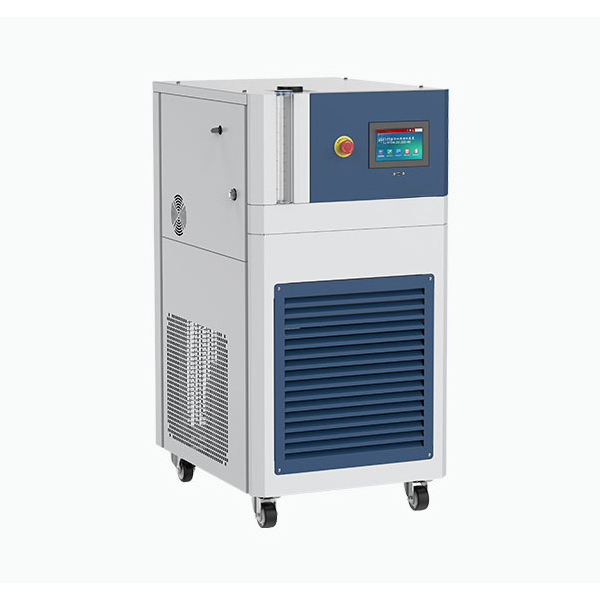
explosion-proof circulation heating thermostat with cooling
Explosion-proof circulation heating thermostat is a kind of high-precision temperature control device suitable for flammable and explosive hazardous places, with the ability of automatic temperature rise and rapid cooling two-way adjustment.
Description
Explosion-Proof Circulation Heating Thermostat
The explosion-proof circulation heating thermostat is engineered for safe and stable operation in hazardous environments. With a fully enclosed circulating structure, pressure-resistant and corrosion-resistant components, and an explosion-proof electrical system, it ensures reliable performance in explosive gas atmospheres and supports air-cooled and water-cooled condensation modes.
Features
- Built for hazardous environments: All electrical components, junction boxes, and operating systems comply with explosion-proof specifications, ensuring safe operation in explosive gas environments.
- Wide temperature range operation: Operates reliably from -40°C to +200°C, suitable for hot and cold alternating reaction needs.
- Integrated module design: Integrates refrigeration, heating, circulation, and intelligent control in one compact system for highly synergistic functions.
- Dual condensing modes: Air-cooled for independent operation, water-cooled for centralized factory cooling, both energy-saving and efficient.
- Precise intelligent control: Supports fixed value and multi-stage program temperature control, with a built-in 7-inch touch screen for real-time display and curve tracking.
- Powerful program control: Configure up to 120 groups of temperature programs, each with 100 segments. Supports linear temperature rise/fall, insulation segment conversion, and complex process control.
- Strong communication and integration: RS485 and MODBUS RTU protocol support, enabling access to DCS and PLC systems for remote monitoring.
- Multiple safety protection: Over-temperature, over-current, delayed start, high-voltage alarm, thermal protection, fault shutdown, and more for comprehensive safety.
- Stable fluid circulation: Liquid level monitoring and expansion tank automatic adjustment maintain heat transfer fluid stability and prevent leaks or backflow.
- Excellent material selection: Key components use 304 stainless steel and polymer explosion-proof materials, providing resistance to corrosion, pressure, low and high temperatures.
Working Principle
- Refrigeration mechanism: Uses rolling rotor compressor refrigeration; refrigerant undergoes compression, condensation, throttling, and evaporation to absorb heat and achieve rapid cooling. Condenser options include air-cooled finned and water-cooled coaxial tube heat exchangers.
- Heating mechanism: Flange-type thermal oil heater inserted into heat-carrying medium for rapid, uniform heating with quick response, able to maintain up to 200°C.
- Fluid circulation principle: High/low temperature resistant shielded pump drives heat transfer fluid in a closed high-speed loop. Expansion vessel absorbs/releases volume changes due to thermal expansion for stable operation.
- Control logic: PID algorithm automatically adjusts heating/cooling power for precise temperature control. Supports fixed value/program control, uniform temperature rise/fall, heat preservation, and real-time data logging. Touch screen displays set temperature, actual temperature, running time, and fault status.
Typical Application Scenarios
- Petrochemical field: Synthesis, purification, catalytic processes requiring reaction temperature control for hazardous materials handling.
- Pharmaceutical and biological reactions: Raw material synthesis, fermentation, crystallization with GMP workshop explosion-proof requirements.
- New energy industry: Battery aging test, superconducting material research, fuel cell cooling with explosion-proof temperature control.
- Paint, dyes, ink industry: Reactor temperature control or condensation collection in organic solvent environments.
- Scientific research/university labs: Experimental reaction systems involving combustible reagents, ensuring personnel safety.
- Hydrogen production/storage systems: Temperature control of hydrogen-related equipment for stable operation under high-pressure conditions.
Technical Parameters
| Model | HC20-18(W) | HC20-11(W) | HC20-7(W) |
|---|---|---|---|
| Temperature range | -40°C to +200°C | ||
| Temperature stability | ±0.5°C | ||
| Overall power | 5.7kw | 11.1kw | 18.6kw |
| Cooling power at 200°C | 12kw | 6kw | 3kw |
| Cooling power at 100°C | 8.6kw | 6kw | 3kw |
| Cooling power at 25°C | 5.8kw | 4.5kw | 2.4kw |
| Cooling power at -10°C | 4.5kw | 4.2kw | 1.4kw |
| Cooling power at -20°C | 3.5kw | 3.2kw | 1.2kw |
| Cooling power at -30°C | 2kw | 2kw | 0.85kw |
| Cooling power at -40°C | 1.1kw | 1.1kw | 0.25kw |
| Heater Rated Power | 12kw | 6kw | 3kw |
| Cooling method | air cooling or water cooling | ||
| refrigerants | R404A | ||
| Circulation pump Flow rate | 45L per minute | 30L per minute | 25L per minute |
| Circulation pump Pressure | 1.4bar | ||
| Circulation Interface Size | R3/4 | ||
| Maximum viscosity of heat-carrying medium | 30cp | ||
| Noise level | 68db | 65db | 68db |
| communication interface | usb, RS485 | ||
| protection class | IP20 | ||
| contamination level | 2 | ||
| Environmental temperature | 5°C to 35°C | ||
| Power supply | 380Vac, 50Hz, 3 phase | ||
| Current | 33A | 20A | 10.5A |
| Electrical Connection Methods | three-phase four-wire system | ||
| External dimensions | 755Wx1300Dx1795H mm | 655Wx1000Dx1480H mm | |
| Weight | 460kg | 430kg | 270kg |