


 English
  Français
  Tiếng Việt
  Italiano
  Nederlands
  Türkçe
  Svenska
  Polski
  Română
  Latviešu
  한국어
한국어  Русский
  Español
  Deutsch
  Українська
  Português
  العربية
  Indonesian
  Čeština
  Suomi
Suomi  Eesti
Eesti  Български
  Dansk
Dansk  Lietuvių
  Bokmål
  Slovenčina
  Slovenščina
  Ελληνικά
  Magyar
  עברית
עברית 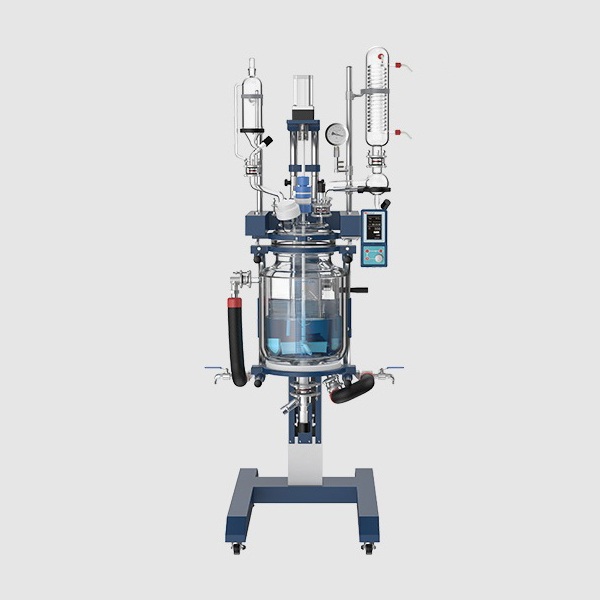
explosion proof lifting glass reactor with 120deg rotation
Explosion proof lifting glass reactor is a multifunctional reaction equipment designed for chemical reaction, synthesis, extraction and pilot scale-up, integrating lifting, rotating, temperature control, vacuum and other functions.
Description
Explosion Proof Lifting Glass Reactor
The explosion proof lifting glass reactor offers safe, flexible, and precise reaction control for high-cleanliness and corrosive/low-temperature scenarios. Its manual vertical lifting and rotating dumping features, along with jacket temperature control and vacuum systems, make it ideal for demanding experimental and production settings.
Main Features
- High-quality Material Construction: 3.3 high borosilicate glass kettle body for outstanding heat shock and corrosion resistance; PTFE-covered stainless steel stirring shaft combines mechanical strength and chemical durability.
- Wide Temperature & Pressure Adaptability: Reaction temperature range -80°C to 200°C, pressure from atmospheric to -0.1MPa; suitable for vacuum and low-temperature operations.
- Manual Lifting & Rotating: Kettle body supports manual lifting and 120° turning for convenient discharging and cleaning.
- Mobility & Stability: Casters with brakes allow for fast movement and secure positioning.
- External Circulation Piping: Transfers pressure stress to the frame, extending kettle lifespan.
- Advanced Digital Control: Real-time digital display for torque, temperature, speed, and time; supports timed operations, online communication, and data export for tracking and analysis.
- Safety & Humanization: Non-accumulating discharge valve, anti-drip inclined port, vacuum gauge feedback for safe and clean operation.
- Explosion-proof Options: Models with explosion-proof functions available for hazardous environments.
Working Principle
- Reaction Stage: Reactants charged from the top, jacketed temperature control, efficient PTFE stirring for mixing.
- Temperature Control: Double-layer jacket with circulating medium, real-time sensor feedback and stainless steel hose connections for stability.
- Vacuum & Discharging: Vacuum pump for depressurization and solvent recovery; inclined release and non-residue valve for thorough and easy discharge.
- Lifting & Rotating: Manual mechanism for lifting and rotating the kettle body, facilitating the handling of precipitated or viscous materials.
Application Areas
- Pharmaceutical Chemistry: Drug synthesis, intermediate reactions, API development with temperature/vacuum control.
- Organic Synthesis: Low temperature, corrosive, and well-stirred reactions (Grignard, condensation, hydrogenation).
- Fine Chemicals: Small batch synthesis and process optimization for spices, dyes, additives, etc.
- Material Science: Polymerization, functional material synthesis, nanomaterial processing.
- Natural Product Extraction: Plant active ingredient extraction, concentration, reaction pretreatment.
- Academia & Research: Laboratory research, pilot scale-up, bridging scientific research and industrialization.
Technical Parameters
| Model | TRL-10 | TRL-10Ex | TRL-20 | TRL-20Ex | TRL-50 | TRL-50Ex |
|---|---|---|---|---|---|---|
| Vessel volume | 10L | 20L | 50L | |||
| Jacket volume | 8L | 9L | 13L | |||
| Funnel volume | 1L | 1L | 1L | |||
| Glass material | High borosilicate glass 3.3 | |||||
| Operating pressure | Ordinary or negative pressure | |||||
| Working temperature | -80°C to 200°C | |||||
| Condenser, cooling area | 0.245 square meters | 0.420 square meters | ||||
| Stirring speed | 20rpm to 500rpm | 50rpm to 500rpm | 20rpm to 500rpm | 50rpm to 500rpm | 20rpm to 500rpm | 50rpm to 500rpm |
| Power supply | 100-240V, 50/60Hz | 220-240V, 50/60Hz | 100-240V, 50/60Hz | 220-240V, 50/60Hz | 100-240V, 50/60Hz | 220-240V, 50/60Hz |
| Drain port, ground clearance | 580mm | 530mm | 570mm | |||
| Lifting distance | 400mm | 400mm | 400mm | |||
| Dimensions, (WxDxH) | 850x1100x2050mm | 860x1100x2500mm | ||||