


 English
  Français
  Tiếng Việt
  Italiano
  Nederlands
  Türkçe
  Svenska
  Polski
  Română
  Latviešu
  한국어
한국어  Русский
  Español
  Deutsch
  Українська
  Português
  العربية
  Indonesian
  Čeština
  Suomi
Suomi  Eesti
Eesti  Български
  Dansk
Dansk  Lietuvių
  Bokmål
  Slovenčina
  Slovenščina
  Ελληνικά
  Magyar
  עברית
עברית 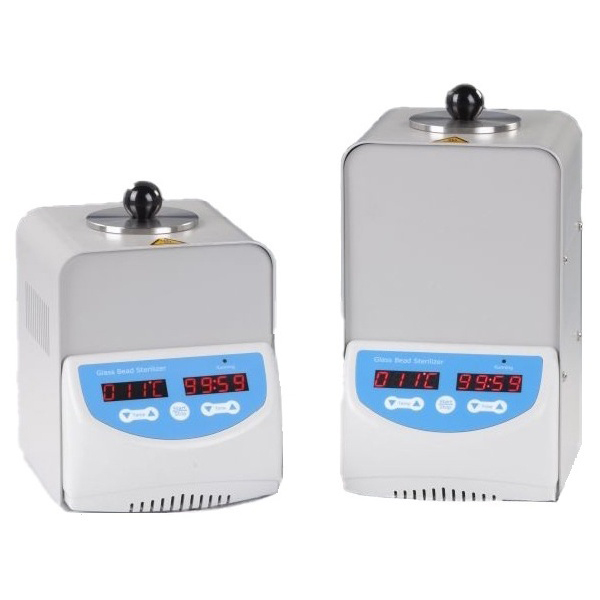
glass bead sterilizer for surgical forceps and scissors
The working principle of glass bead sterilizer is based on heating the glass beads and keeping them at high temperature, the contacted instruments will be completely sterilized in a very short time, which is widely used in microorganisms, cell culture, tissue engineering, animal experiments and basic medical research and other experimental places.
Description
Main features of glass bead sterilizer:
- high temperature sterilization efficiency: sterilization beads can be heated up to 300°C, rapidly inactivating bacteria, viruses, fungi and spores within 10 seconds.
- real-time digital display: integrated temperature real-time monitoring and countdown function, to ensure that each sterilization is accurate and controllable.
- Ready-to-use design: fast preheating, suitable for frequent insertion and removal of tools, to meet the needs of high-throughput experiments.
- compact and safe structure: occupies a small space, the equipment is closed inside with high security, and the shell is made of high-temperature resistant material, suitable for long-term use on the experimental desktop.
- easy maintenance: no liquid or chemical reagents, no exhaust system, clean and convenient, no cross-contamination hazards.
Advantage Analysis
- high efficiency and speed: far faster than the traditional oven or alcohol lamp sterilization, suitable for experiments in a compact rhythm of the scene.
- green and environmental protection: pure physical sterilization, without alcohol or disinfectant, to avoid chemical residues and volatiles pollution.
- Energy-saving and durable: the core heating components have a long life, glass beads can be reused, low operating costs.
- high degree of automation: some models have automatic timing function, sterilization process without repeated human operation.
Working Principle
The core principle of glass bead sterilizer is dry heat sterilization, through the built-in heating module will be a pool of high-purity glass beads quickly heated to a set temperature (usually 250 °C ~ 300 °C), when the metal or glass instruments are partially inserted into the glass beads, the heat is instantly transferred to the surface of the instruments, through the high temperature to destroy the microbial cell membranes and protein structure, to achieve complete inactivation.
Application Areas
- Microbiology laboratory: for rapid sterilization of tools such as inoculation rings, inoculation needles, test tube holders and so on.
- cell culture and molecular biology: alternative to open flame sterilization of inoculation equipment to improve safety.
- Laboratory animal center: rapid sterilization of clamping and cutting tools before animal dissection or operation to reduce the risk of infection.
- hospitals and outpatient clinics: dental, ophthalmic or operating room for rapid sterilization of small instruments.
- teaching and research places: for daily laboratory teaching operations and research experiments to protect.
Technical Parameters
| Model | GB10 | GB20 |
|---|---|---|
| Temperature Range | 100°C to 300°C | |
| Temperature Accuracy | ±5°C | |
| Display Accuracy | 1°C | |
| Heating Time | ≤25 minutes, ambient to 300°C | |
| Allowed Glass Bead Weight | 150g | 300g |
| Dimensions | 176x135x200mm | 176x135x250mm |
| Weight | 2.5kg | 3.3kg |
| Power Supply | 230Vac, 50-60Hz | |
| Power | 120W | 250W |