


 English
  Français
  Tiếng Việt
  Italiano
  Nederlands
  Türkçe
  Svenska
  Polski
  Română
  Latviešu
  한국어
한국어  Русский
  Español
  Deutsch
  Українська
  Português
  العربية
  Indonesian
  Čeština
  Suomi
Suomi  Eesti
Eesti  Български
  Dansk
Dansk  Lietuvių
  Bokmål
  Slovenčina
  Slovenščina
  Ελληνικά
  Magyar
  עברית
עברית 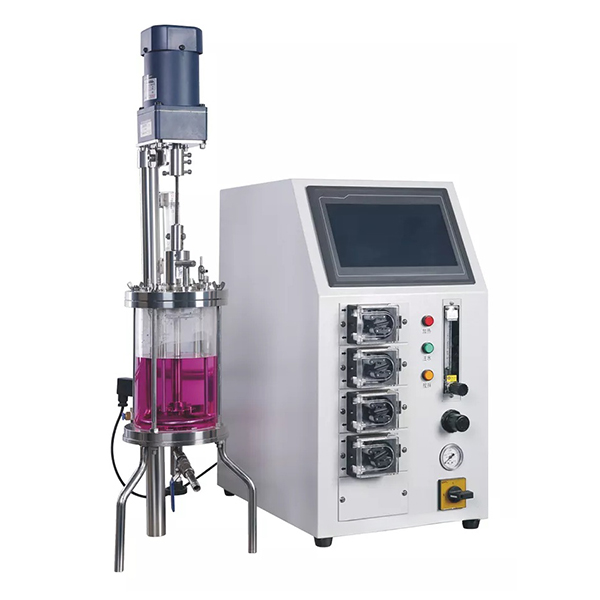
glass enzyme reactor with magnetic or mechanical stirring
Glass enzyme reactor is a kind of reaction equipment specially used for enzyme catalyzed reaction, which is widely used in the fields of biochemical reaction, enzyme reaction and industrial fermentation.
Description
Glass Enzyme Reactor
The glass enzyme reactor is made of highly transparent glass, which is easy to observe the reaction process and suitable for experimental and pilot applications that require strict reaction conditions such as temperature, pH and gas flow.
Features
- Top mechanical stirring: the use of top mechanical stirring device can effectively ensure the uniform mixing of the reaction liquid and ensure the stability of the enzyme catalyzed reaction. The top stirring design not only improves the contact efficiency of gas and liquid, but also avoids the deposition and scale accumulation problems that may be caused by the bottom stirring.
- Special air distribution ring: Equipped with air distribution ring to form a uniform airflow distribution in the reactor, which helps to enhance the contact area between gas and liquid, and enhance the gas-liquid mixing effect, thus improving the reaction rate and enzyme catalytic efficiency. This design is suitable for biological reaction processes that require gas participation, such as aerobic fermentation.
- Bottom screen retention structure: the bottom of the reactor is designed with a screen retention structure, which can effectively recover the catalyst for enzyme reaction and prevent it from being lost in the reaction process. This design improves the efficiency of the catalyst, reduces the cost of the reaction, and also helps the enzyme to be used many times, which improves the economic efficiency.
Working Principle
- The working principle of the glass enzyme reactor is based on enzyme-catalyzed reaction. The enzyme catalyst in the reactor ensures the full mixing of reactants and gases through the dual action of the top mechanical stirring device and air distribution ring, which in turn enhances the reaction rate. Through the precision-controlled temperature control system and pH adjustment device, it ensures that the environmental conditions during the reaction process are always kept within the range suitable for enzyme activity.
- During the reaction process, the bottom screen retention structure will capture and recycle the enzyme catalyst to avoid its loss and improve the efficiency and economy of the reaction. The reactor is designed to consider the good contact between gas and liquid phases, and at the same time effectively manage the distribution of gas to reduce the waste of gas.
Application Areas
- Biopharmaceutical industry: In the field of biopharmaceuticals, glass enzyme reactor can be used for enzyme catalytic reaction, protein expression and purification, enzyme modification and optimization, etc., which plays an important role in drug synthesis and biotransformation process.
- Food and beverage industry: used in enzymatic reaction, fermentation reaction, fruit juice brewing, beer brewing and other production processes, effectively improve production efficiency and product quality. For example, the production of fructose and food enzymatic process, can effectively decompose and extract useful components.
- Environmental protection industry: In the process of wastewater treatment, garbage treatment and biodegradation of organic waste, glass enzyme reactor can efficiently decompose pollutants through enzyme-catalyzed reaction and help to achieve environmental protection goals.
- Scientific research experiment: It is suitable for all kinds of enzyme reaction experiments, fermentation process development and optimization, metabolic pathway analysis and other scientific research fields, providing a reliable experimental platform for academic research.