


 English
  Français
  Tiếng Việt
  Italiano
  Nederlands
  Türkçe
  Svenska
  Polski
  Română
  Latviešu
  한국어
한국어  Русский
  Español
  Deutsch
  Українська
  Português
  العربية
  Indonesian
  Čeština
  Suomi
Suomi  Eesti
Eesti  Български
  Dansk
Dansk  Lietuvių
  Bokmål
  Slovenčina
  Slovenščina
  Ελληνικά
  Magyar
  עברית
עברית 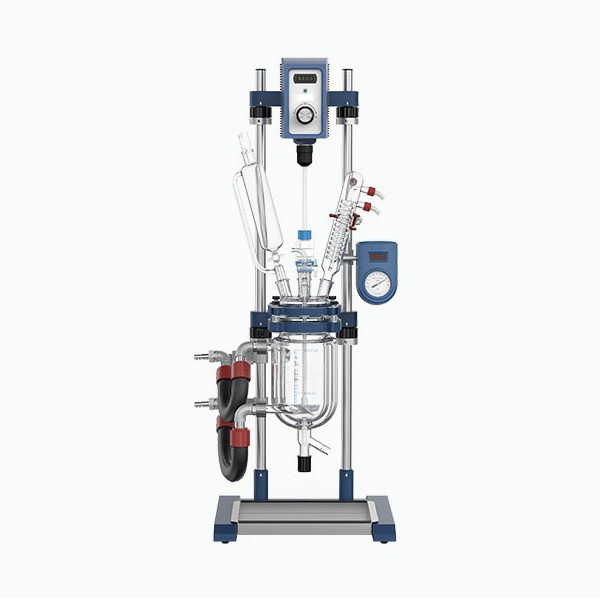
glass reactor with variable speed for distillation
The glass reactor is equipped with jacketed temperature control system, stirring system, vacuum interface and discharge structure, which is suitable for the occasions with precise control of reaction conditions.
Description
Glass Reactor
The glass reactor is crafted from high borosilicate glass for exceptional transparency, heat resistance, and chemical corrosion resistance. Widely used in university laboratories, scientific research units, chemical, pharmaceutical, and biological engineering fields, it provides reliable and precise control for a variety of reaction environments.
Main Features
- Superior Temperature & Pressure Resistance: 3.3 borosilicate glass maintains stability from -80°C to 200°C and withstands vacuum up to -0.1MPa for low temperature and depressurized reactions.
- Insulated Stainless Steel Hose: Jacket inlet/outlet use stainless steel insulated hoses to reduce thermal stress and prevent glass rupture.
- Non-accumulating Liquid Discharge Valve: Designed to minimize residual liquid and simplify cleaning.
- Sturdy Bracket Design: Stainless steel, carbon steel spraying, and aluminum alloy composite bracket for beauty, corrosion resistance, and ease of cleaning.
- Bottom Receiving Tray: Stainless steel tray to prevent environmental pollution from leaks.
- Integrated Vacuum Gauge & Control Panel: Real-time monitoring of system pressure and operating parameters.
- Imported Stirring Bearings: Stable operation with no falling chips to keep reaction environment pure.
- PTFE-coated Stirring Blades & Shaft: Excellent corrosion resistance for strong acid and alkali systems.
- Real-time Display: Temperature and rotational speed shown on display for manual or fixed-speed control.
Working Principle
- Temperature of reaction medium regulated via jacket structure; coolant or heat-conducting oil provides stable heat/cold source controlled externally.
- PTFE-coated stainless steel shaft and paddles form fluid circulation, enhancing heat transfer and mixing.
- Vacuum pump connection enables depressurized reactions for improved efficiency and concentration.
- Up-top inclined discharging structure allows for smooth, low-residue material discharge, simplifying operation and cleaning.
Application Areas
- Organic Synthesis: Multi-step synthesis, condensation, esterification, reduction reactions.
- Pharmaceutical R&D: Pilot scale-up, drug intermediates, impurity studies.
- Natural Product Extraction: Plant extraction, decolorization, purification.
- New Material Development: Polymerization, nanoparticle dispersion and reaction.
- Teaching & Scientific Research: Standardized reaction platform for universities and institutes.
- Chemical Process Optimization: Pilot stage reaction parameter and process determination for enterprises.
Technical Parameters
| Model | TR-1 | TR-2 | TR-3 | TR-5 | TR-5Ex |
|---|---|---|---|---|---|
| Vessel volume | 1.0L | 2.0L | 3.0L | 5.0L | 5.0L |
| Jacket volume | 1.2L | 1.7L | 2.0L | 3.0L | 1.5L |
| Funnel volume | 0.2L | 0.5L | |||
| Pressure in the vessel | -0.1mpa to 0.0mpa | ||||
| Pressure in the jacket | ≤0.03mpa | ||||
| Working temperature | -80°C to 200°C | ||||
| Stirring speed | 40rpm to 500rpm | 20rpm to 500rpm | 50rpm to 500rpm | ||
| Power supply | 220-240Vac, 50Hz, 60HZ or 110Vac, 60Hz | 100-240V, 50/60Hz | 220-240V, 50/60Hz | ||
| Dimensions(WxDxH) | 480x420x1110mm | 480x420x1020mm | 480x420x1200mm | 640x520x1600mm | |