


 English
  Français
  Tiếng Việt
  Italiano
  Nederlands
  Türkçe
  Svenska
  Polski
  Română
  Latviešu
  한국어
한국어  Русский
  Español
  Deutsch
  Українська
  Português
  العربية
  Indonesian
  Čeština
  Suomi
Suomi  Eesti
Eesti  Български
  Dansk
Dansk  Lietuvių
  Bokmål
  Slovenčina
  Slovenščina
  Ελληνικά
  Magyar
  עברית
עברית 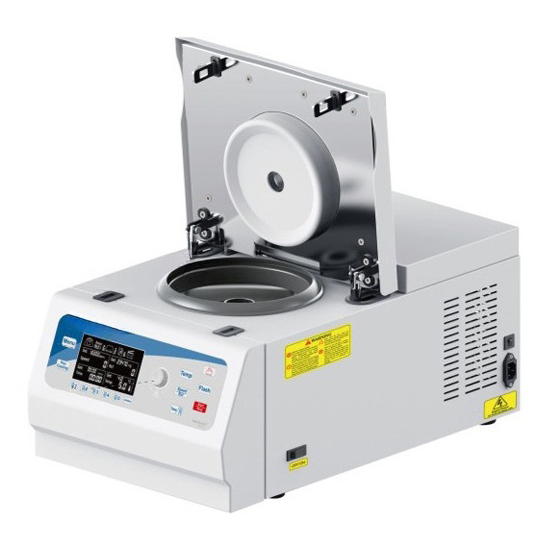
high speed refrigerated centrifuge with -20°C to +40°C range
The high speed refrigerated centrifuge is a high performance, versatile and widely adaptable piece of laboratory equipment designed for routine analysis in medical, biological and industrial laboratories.
Description
High Speed Refrigerated Centrifuge
Main Features
- Temperature control range: -20°C to +40°C, stably maintains -4°C to +4°C during high-speed operation—ensures sample activity and integrity.
- Rapid pre-cooling: Quickly lowers sample temperature, ideal for rapid freezing needs.
- Continuous temperature control: Maintains set temperature even when idle—prevents external fluctuations from affecting samples.
- Automatic standby: Switches to standby when not in use—optimizes cooling and extends compressor life.
- Robust, durable build: Stainless steel chamber for high-load, long-term use.
- User-friendly interface: 5-inch LCD display with clear, real-time settings and operational feedback.
- Rotor automatic identification: Auto-adapts to different rotor types for safe, convenient operation.
- Comprehensive safety: Overspeed, imbalance, and lid protection—real-time monitoring for accident prevention.
- Low noise: Quiet lid operation and efficient design—maintains a peaceful lab environment.
- Instant centrifugation: Dedicated button for rapid centrifugation—boosts workflow efficiency.
Advantages
- Precise temperature control: Wide, accurate range for sensitive sample handling.
- High speed & control: Brushless frequency conversion motor, 100–16,000rpm, precise centrifugal force adjustment.
- Multi-functional rotor support: Compatible with 1.5ml/2.2ml, capillary, 5ml, 0.2ml, and more—supports diverse sample volumes.
- High safety: Automated monitoring and protection systems for safe, stable operation.
- Corrosion resistance: Rotor/chamber materials resist chemicals—extends equipment life.
- Easy operation: Intuitive controls, auto rotor ID, preset programs—streamlines experimental workflow.
Working Principle
High-speed rotation generates centrifugal force, efficiently separating sample components by density. Refrigeration system maintains low temperature, preserving sensitive molecules (proteins, nucleic acids) and preventing thermal damage.
- Centrifugal force principle: High-speed rotor separates sample components by density within the tube.
- Temperature control principle: Refrigeration system keeps samples stable, minimizing heat effects.
Application Fields
- Medical labs: Blood, cell, culture fluid separation for diagnostics and hematology.
- Molecular biology: DNA/RNA/protein purification, genetic engineering, transgenic research.
- Biochemistry: Enzymology, immunology, metabolic studies—separates diverse molecules.
- PCR product processing: DNA fragment extraction, purification, and concentration post-PCR.
- Industrial analysis: Food/pharma sample separation for raw material and quality testing.
Rotor Types
- 24 × 1.5/2.2ml rotor: Small-volume biological samples (cells, blood, etc.)
- 24 × capillary rotor: Blood analysis in clinical settings.
- 10 × 5ml rotor: Medium-volume samples for drug/chemical analysis.
- 4 × 8 × 0.2ml rotor: Small-volume PCR sample separation.
- 36 × 0.5ml rotor: High-throughput, small-volume sample processing.
Technical Parameters
| Model | C11 |
|---|---|
| Speed range | 100rpm to 16000rpm |
| Speed accuracy | ±10rpm |
| relative centrifugal force | 23470xg |
| Capacity | 1.5mlx24, 2.2mlx24, Capillary blood volume tube X24, 5mlx10, PCR 0.2mlx8x4 |
| Timer | 0 to 99minutes 59seconds or continuously |
| Motor type | brushless dc motor |
| Temperature range | -20°C to +40°C |
| Display screen | LCD |
| Safety | safety lid-lock, imbalance system |
| Acceleration and deceleration | 20 seconds |
| Power supply | 200Vac to 240Vac,50Hz, 60Hz |

high speed refrigerated centrifuge rotors