


 English
  Français
  Tiếng Việt
  Italiano
  Nederlands
  Türkçe
  Svenska
  Polski
  Română
  Latviešu
  한국어
한국어  Русский
  Español
  Deutsch
  Українська
  Português
  العربية
  Indonesian
  Čeština
  Suomi
Suomi  Eesti
Eesti  Български
  Dansk
Dansk  Lietuvių
  Bokmål
  Slovenčina
  Slovenščina
  Ελληνικά
  Magyar
  עברית
עברית 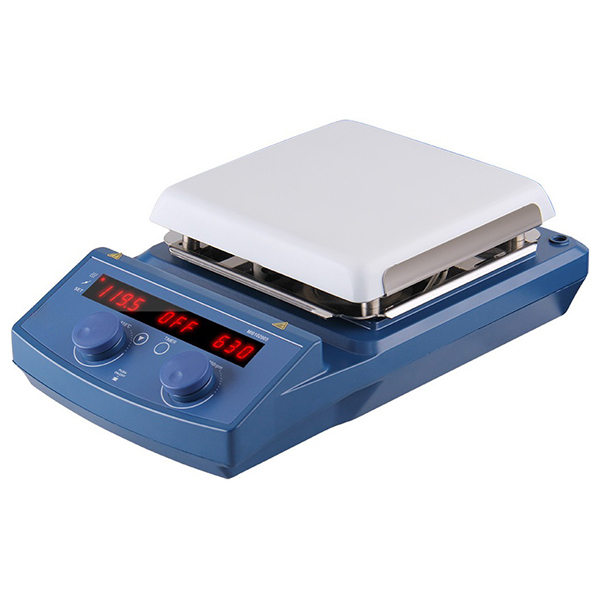
hotplate magnetic stirrer with temperatures up to 510°C
Hotplate magnetic stirrer is a kind of laboratory basic equipment integrating stirring and heating. The main function is to realize efficient stirring of liquid or mixed solution while controlling the temperature, which is applicable to a variety of solution volumes up to 20 liters.
Description
Hotplate Magnetic Stirrer
Main Features
- High-temperature heating: Ceramic-coated stainless steel plate heats up to 510 °C for most laboratory applications.
- Intelligent temperature control: Advanced PID algorithms ensure fast response, stable control, and wide/high-accuracy temperature range.
- Intuitive interface: Large LED dual display shows set/actual temperature and speed in real time for easy operation.
- Ceramic-coated heating plate: Wear-resistant, acid/alkali corrosion-resistant, highly efficient, and easy to clean/maintain.
- Fully enclosed alloy shell: Excellent heat/corrosion resistance and good heat dissipation.
- High-efficiency brushless DC motor: Maintenance-free, stable at high speed (up to 1500 rpm)—keeps 5L liquid mixing smoothly.
- Multiple safety guarantees: Dual hardware/software over-temperature protection and 50 °C hot surface warning system.
- External probe support: PT1000 sensor auto-recognition for precise temperature control—ideal for constant temperature reactions.
- Timing function: 0–99h 59min timer to meet diverse experimental needs.
Core Advantages
- Highly integrated: Heating, stirring, and temperature control in one—space-saving and efficient.
- Accurate/reliable: PID temperature control and stable speed for repeatable, trustworthy experiments.
- Strong safety: Comprehensive over-temperature protection and hot surface warning for operator/lab safety.
- High durability: Quality materials withstand harsh environments and extend equipment life.
Working Principle
Magnetic drive and heat transfer: A motor generates a rotating magnetic field, spinning a stir bar in the liquid for continuous mixing. The heating plate transfers heat to the vessel, with PID algorithms adjusting power and speed in real time for stable conditions. PT1000 sensors enable precise sample temperature monitoring for closed-loop control, ensuring accurate thermodynamic reactions.
Application Areas
- Biological labs: Dissolving media, stirring buffers, reagent prep.
- Chemical synthesis: Reactions, solution mixing, crystallization.
- Pharmaceutical engineering: Drug development—dissolution, mixing, homogenization.
- Food testing/development: Sample pretreatment, component mixing.
- Environmental science: Water analysis, sample extraction.
- Materials research: Sol-gel, nanomaterial synthesis, high-temp processes.
Technical Parameters
| Model | T10HS |
|---|---|
| Temperature range | 50°C to 510°C |
| Temperature resolution | 0.1°C |
| Temperature accuracy | ±1°C |
| Stirring volume | 20L |
| Platform dimensions | 185x185mm |
| Heating plate material | ceramic surface |
| Heating power | 1000W |
| Speed range | 50rpm to 1500rpm |
| Motor type | brushless dc motor |
| Motor power | 15W |
| Stirrer size | ≤80xф9.5mm |
| Display | LED |
| Timer | 0 to 99 hours 59 minutes |
| External dimensions | 220x350x100mm |
| Power supply | 200Vac to 240Vac,100Vac to 120Vac, 50/60Hz |
| Power | 1050W |
| Weight | 4.0kg |