


 English
  Français
  Tiếng Việt
  Italiano
  Nederlands
  Türkçe
  Svenska
  Polski
  Română
  Latviešu
  한국어
한국어  Русский
  Español
  Deutsch
  Українська
  Português
  العربية
  Indonesian
  Čeština
  Suomi
Suomi  Eesti
Eesti  Български
  Dansk
Dansk  Lietuvių
  Bokmål
  Slovenčina
  Slovenščina
  Ελληνικά
  Magyar
  עברית
עברית 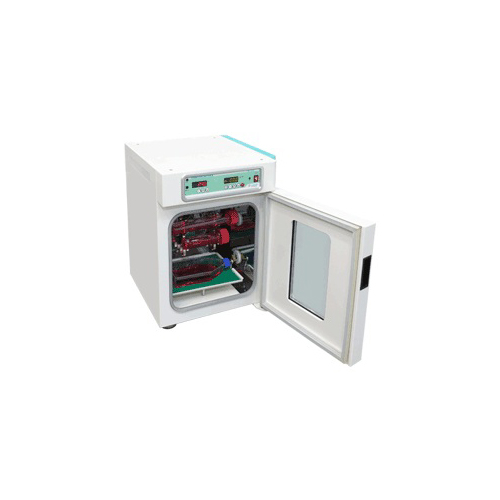
hybridization incubator for study of nucleic acid molecules
Hybridization incubator is a high-precision temperature control equipment designed for nucleic acid hybridization experiments, widely used in genetic testing, molecular diagnostics and life science research fields.
Description
Hybridization Incubator
Integrating temperature control, rotation, and shaking functions, the hybridization incubator automates and precisely controls key steps in nucleic acid hybridization, such as denaturation, pre-hybridization, hybridization, and membrane washing. It is essential equipment for improving molecular hybridization efficiency and experimental reproducibility.
Main Features
- Modular Structure: Compact, modular assembly allows for easy maintenance and upgrades; functional layout is optimized for convenience.
- Intelligent Control System: Microcomputer and large touch screen display real-time temperature, time, and speed; intuitive and user-friendly interface.
- High-quality Materials: Inner liner and hybridization bracket are made of corrosion-resistant 304 stainless steel; UV-resistant toughened glass door enhances safety and visibility.
- Precision Temperature Control: Fuzzy logic and PID algorithms deliver ±0.5 °C accuracy, rapid response, and minimal fluctuation.
- Efficient Rotating System: Direct-drive motor ensures constant, smooth tube rotation, unaffected by power fluctuations.
- Multi-functional Shaking Platform: Independent shaking device on the bottom accommodates hybridization bags, expanding experimental options.
Core Advantages
- Integrated Temperature Control: Enables continuous, full-process control from baking to membrane washing, reducing human error and enhancing signal quality.
- High Compatibility: Fits multiple hybridization tube/bag specifications; one machine supports various experimental protocols, reducing equipment investment.
- Simple Operation: Knob and quick-lock design for fast, easy tube loading/unloading.
- Superior Safety: Anti-scald structure and UV protection minimize operational risks.
- Energy-saving & Quiet: Low power motor and sound insulation shell are ideal for quiet labs.
Working Principle
The incubator maintains a thermostatic environment for nucleic acid hybridization at optimal temperatures and gentle rotation. Key process steps include:
- Denaturation: Converts double-stranded nucleic acids to single strands.
- Annealing/Hybridization: Gradual cooling enables target sequences to bind complementary probes.
- Elution: Removes unbound probes, enhancing signal-to-noise ratio.
The high-precision heating module stabilizes hybridization temperature, while the rotating system ensures uniform mixing for efficient reactions and consistent signals.
Application Areas
- Nucleic acid hybridization experiments: Northern/Southern blot, probe labeling and detection.
- Gene cloning screening: Detection of positive clones via radiolabeled/fluorescent probes.
- Hybridization signal enhancement and membrane incubation: High specificity for high-background samples.
- Gel staining and decolorization: Uniform staining/elution at constant temperature.
- Microorganism and cell incubation: Temperature-sensitive culture, e.g., strain preculture for hybridization screening (select models).
Technical Parameters
| Model | BN10 |
|---|---|
| Temperature Control Range | ambient +8°C to 100°C |
| Temperature Control Accuracy | ±0.5°C |
| Temperature Resolution | 0.1°C |
| Temperature Equilibration Time | less than 20 minutes |
| Rotation Speed | 0 to 30rpm, variable |
| Hybridization Tube Specifications | Standard configuration: 2 pieces of diameter 35x240mm, Optional configuration: diameter 35x150mm and diameter 35x300mm |
| Data Storage | 50 sets |
| Power supply | 220Vac, 50Hz, 800W |