


 English
  Français
  Tiếng Việt
  Italiano
  Nederlands
  Türkçe
  Svenska
  Polski
  Română
  Latviešu
  한국어
한국어  Русский
  Español
  Deutsch
  Українська
  Português
  العربية
  Indonesian
  Čeština
  Suomi
Suomi  Eesti
Eesti  Български
  Dansk
Dansk  Lietuvių
  Bokmål
  Slovenčina
  Slovenščina
  Ελληνικά
  Magyar
  עברית
עברית 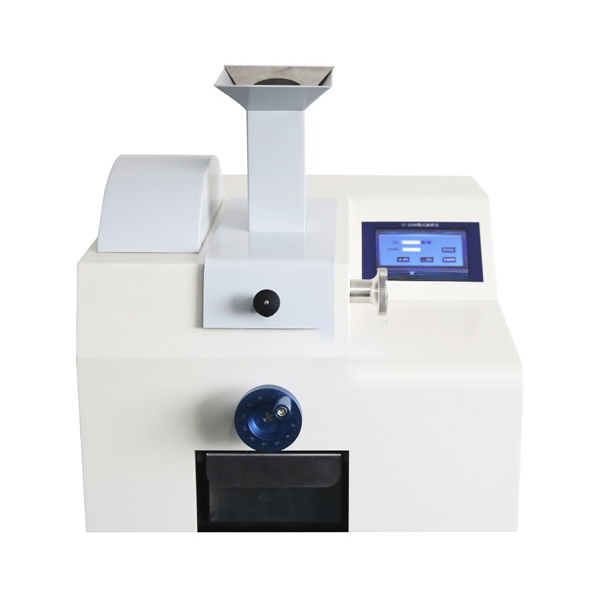
jaw crusher for crushing samples by mutual extrusion of jaws
Jaw Crusher is a kind of primary crushing equipment for solid materials commonly used in laboratories, and its main function is to quickly crush hard samples of larger sizes to smaller particle sizes for subsequent pulverization, analysis or other physicochemical processing.
Description
Jaw Crusher
Jaw Crusher is widely used in many scientific research fields such as geological analysis, material research, environmental testing and marine sample processing, and is suitable for handling brittle materials with high and medium hardness.
Jaw Crusher is widely used because it has the advantages of simple structure, reliable operation and fast processing speed, which is suitable for high-frequency laboratory sample preparation work.
Features
- Compact structure, desktop design: suitable for all kinds of laboratory space, easy to install.
- Rapid adjustment of the discharge particle size: by adjusting the distance between the jaws, you can quickly control the sample crushing size.
- Double safety interlock system: the equipment automatically stops running when the feed hopper is opened or the collection box is not in position, which improves the safety of use.
- Multi-material jaws optional: according to the nature of the sample to choose stainless steel, high manganese steel, zirconium oxide and other different materials, effectively avoid cross contamination.
- Support forward and reverse switching: Prevent blockage caused by jammed material and make the operation smoother.
- Easy to maintain and clean: feeding system can be opened and disassembled, grinding chamber cleaning more thoroughly.
- Low noise operation: built-in shock absorption design, reduce noise interference, improve the laboratory environment.
Working Principle
The core working principle of the jaw crusher is mechanical extrusion crushing. When the device is started, a fixed jaw plate and a movable jaw plate are installed relative to each other to form a V-shaped crushing chamber. After the sample is fed from the top, the movable jaw plate is driven by the motor for periodic reciprocating motion, and the sample is continuously compressed, sheared and crushed between the jaw plates.
When the movable jaw plate is close to the fixed jaw plate, the sample is crushed by pressure. when the movable jaw plate is far away, the crushed particles are naturally discharged from the bottom of the crushing chamber under the effect of gravity. By adjusting the gap between the jaws, the final size of the discharged material (usually from 1mm to tens of millimeters) can be flexibly controlled.
In addition, the material and structural design of the jaws determine their wear resistance and crushing efficiency. Different materials are suitable for different samples, e.g. zirconium oxide jaws can be used for ceramic samples to avoid metal contamination.
Typical Application Areas
- Geology and mineral resources: for granite, basalt, quartz ore, metal ores and other samples of the pretreatment, sample size reduction for X-ray fluorescence analysis, mineral composition analysis.
- Construction and materials industry: cement clinker, slag, stone and other building materials samples for crushing detection. Preparation of ceramic raw materials, such as clay, electric porcelain, sintered ceramics.
- Glass and chemical raw materials: coarse crushing of glass powder and its production raw materials to improve mixing efficiency.
- Environmental Science and Agricultural Soil: Crushing of soil samples and solid waste for heavy metal detection and pollution assessment.
- Marine biology and food field: Crushing and analysis of hard biological materials such as dried shells, dried sea cucumbers, etc. to support biomineralization research.
Technical Parameters
| Model | JW200 |
|---|---|
| Feed size | ≤ 50mm |
| Discharge size | ≤0.25mm |
| Zero point-calibration | Yes |
| Speed | 100 to 1000rpm adjustable |
| Funnel | can be overturned |
| Sample size adjustment range | 0 to 12mm, adjustable |
| Motor power | 1.1kw |
| Power supply | 220Vac 50, 60Hz |
| Lapping kit material | High manganese steel, stainless steel, steel, zirconium oxide, tungsten carbide, industrial plastic |
| Net weight | 95kg |
| Dimensions | 450x630x490mm |