


 English
  Français
  Tiếng Việt
  Italiano
  Nederlands
  Türkçe
  Svenska
  Polski
  Română
  Latviešu
  한국어
한국어  Русский
  Español
  Deutsch
  Українська
  Português
  العربية
  Indonesian
  Čeština
  Suomi
Suomi  Eesti
Eesti  Български
  Dansk
Dansk  Lietuvių
  Bokmål
  Slovenčina
  Slovenščina
  Ελληνικά
  Magyar
  עברית
עברית 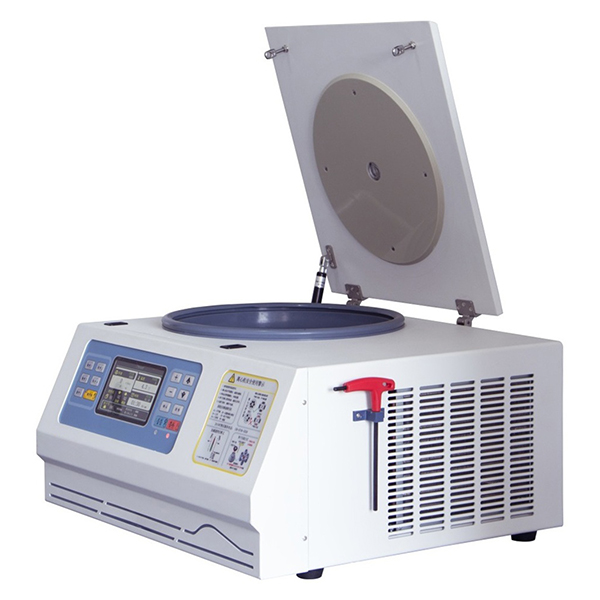
Low speed refrigerated centrifuge with 4 units of 250ml
Low speed refrigerated centrifuge is an efficient laboratory equipment combining low-speed centrifugation and cooling functions, designed for handling samples that require a low-temperature environment.
Description
Low Speed Refrigerated Centrifuge
Low speed refrigerated centrifuge is widely used in clinical medicine, molecular biology, cytology and other fields, suitable for those temperature sensitive samples, such as proteins, cells and other biological samples.
Features
- Efficient speed and capacity: the speed reaches 5500rpm, which is suitable for most low-speed centrifugation needs. Equipped with four 250ml large-capacity rotary heads, it is capable of handling multiple samples, which greatly improves the working efficiency.
- Intelligent control system: equipped with program group shortcut keys and large storage space, can store 99 program groups, easy to call at any time. Supporting the electric door lock function, you can choose whether to open the chamber door automatically after centrifugation, to enhance the convenience of operation. Equipped with long-press start and instantaneous centrifugation function, suitable for rapid processing of special samples.
- Temperature control and acceleration function: built-in special insulation process to ensure temperature stability during centrifugation, avoid refrigerant loss and ensure cooling effect. Equipped with linear drive system, it provides 10 acceleration and 10 deceleration settings, which can adjust the separation speed according to the needs of different samples and ensure the separation effect.
- Multiple protection and safety features: the equipment has a rotor automatic identification system, which can prevent the safety hazards caused by wrong operation. Electromagnetic induction door protection and double electronic door lock design, as well as over-speed, over-temperature, imbalance and other multiple warning protection functions to ensure the safety of operation. The body is protected by a three-layer all-steel structure, which enhances the stability and durability of the equipment.
- Energy efficiency and environmentally friendly design: equipped with ECO automatic standby function, in the case of 8 hours unused automatically enter standby mode, reduce energy consumption and extend the life of the compressor.
- Convenient detail design: the front of the body is designed with an operating SOP, standard operating procedures guide chart, to help experimenters more simple and standardized operation. Random tool holder and quick locking rotor cover design improves operation convenience and safety. Noise reduction system effectively reduces the operating noise, providing a more comfortable working environment for experimental personnel.
Working Principle
- The core principle of the low speed refrigerated centrifuge is to utilize the centrifugal force generated when the rotor rotates at a high speed to separate different components in the sample according to their density differences. During centrifugation, the separation process can be precisely controlled by adjusting the speed, time and acceleration/deceleration settings. The refrigeration system maintains a low-temperature environment in the centrifugal chamber through the internal refrigeration mechanism to prevent denaturation or degradation of the samples due to temperature increase at high rotational speeds.
- The cooling system of the equipment adopts highly efficient refrigerant and special insulation process, which can effectively prevent temperature fluctuation during the centrifugation process and maintain the stability of the samples. Meanwhile, the intelligent control system of the centrifuge can real-time display centrifugal force, speed, time and other parameters, and can be adjusted at any time without stopping the machine during operation, ensuring the flexibility of operation and high efficiency of the experiment.
Application Areas
- Clinical medicine: In hematology, microbiology and other fields, it is used to separate serum, plasma, cells and other samples, and is widely used in disease diagnosis, blood analysis and other clinical experiments. It is suitable for clinical research work such as cell culture, virus extraction and protein separation.
- Molecular biology and genetics: for DNA, RNA extraction, protein purification, etc., widely used in genomics, molecular cloning, proteomics and other research fields. In cytology research, low-temperature centrifugation helps to avoid thermal damage to samples during centrifugation and ensures that biomolecules are not degraded.
- Cytology and biology research: suitable for cell separation, cell cultures, in experiments involving cell cycle, cell extraction, cell lysis, etc., the low temperature environment can effectively avoid the impact of the temperature change of the cells on the experimental results.
- Pharmaceutical and biological products: in drug development, widely used in the separation and purification of biological drugs, protein drugs in the production process. It is also applicable to the development and production of biological products such as antibody preparation and vaccine research.
- Food and environmental science: used in the food industry for component separation, nutritional extraction, etc.. also can be used for environmental sample analysis, such as soil, water samples, air sample processing and separation. It can be used in environmental monitoring, chemical analysis and other fields to separate a variety of substances, applicable to the analysis of pollutants, microbial research.
- Scientific research and education: in college laboratories and research institutions, low speed refrigerated centrifuge has become the basic scientific research tool for molecular biology, chemistry, environmental science and other disciplines. In life science, chemical reaction, experimental teaching, etc., it provides an efficient and precise experimental means.
Technical Parameters
| Model | CL10R |
|---|---|
| Maximum speed | 5500rpm |
| Maximum RCF | 4919xg |
| maximum capacity | 4x250ml |
| Rotation Speed Accuracy | ±10rpm |
| Timer | 1 second to 99 hours 59 minutes |
| Temperature setting range | -20°C to 40°C |
| Temperature Accuracy | ±1.0°C |
| Noise | ≤60dB |
| Rotor Identification | yes |
| Power supply | 230Vac, 50Hz, 10A |
| Power | 1000W |
| Overall dimensions | 595x660x365mm |
| Net weight | 89kg |
| Rotor name | rotor number | ordinal number | Volume | Maximum speed | Maximum RCF |
|---|---|---|---|---|---|
| rotor angular rotor | 1 | 1 | 6x50ml | 5500rpm | 3645xg |
| 2 | 2 | 40x15ml | 5000rpm | 4919xg | |
| Multi-tube rack horizontal rotor body | 3 | 3 | Required for use with pipe racks | ||
| tube rack | 3 | 4 | 4x50ml | 4000rpm | 2951xg |
| 5 | 4x100ml | ||||
| 6 | 8x50ml | 4000rpm | 2951xg | ||
| 7 | 8x100ml | ||||
| 8 | 16x10/15ml | ||||
| 9 | 24x10/15ml | ||||
| 10 | 32x10/15ml | ||||
| 11 | 48x2ml to 7ml, Vacuum Blood Collection Tubes | ||||
| 12 | 64x5ml, Vacuum Blood Collection Tubes | ||||
| Horizontal rotor | 4 | 13 | 4x250ml round cups | 4000rpm | 3040xg |
| 14 | 4x250ml round cups with biosafety lids | 4000rpm | 3040xg | ||
| 15 | 4x250ml oval cups | 4000rpm | 3040xg | ||
| Horizontal rotor body | 4 | 16 | Horizontal rotor body 4x250ml | ||
| tube rack | 4 | 17 | 56x5ml, vacuum blood collection tube | 4000rpm | 3040xg |
| 18 | 16x50ml tip, round bottom universal | 4000rpm | 3040xg | ||
| 19 | 36x15ml | 4000rpm | 3040xg | ||
| Horizontal rotor | 5 | 20 | 2x2x96-well enzyme labeling plate | 4000rpm | 2057xg |