


 English
  Français
  Tiếng Việt
  Italiano
  Nederlands
  Türkçe
  Svenska
  Polski
  Română
  Latviešu
  한국어
한국어  Русский
  Español
  Deutsch
  Українська
  Português
  العربية
  Indonesian
  Čeština
  Suomi
Suomi  Eesti
Eesti  Български
  Dansk
Dansk  Lietuvių
  Bokmål
  Slovenčina
  Slovenščina
  Ελληνικά
  Magyar
  עברית
עברית 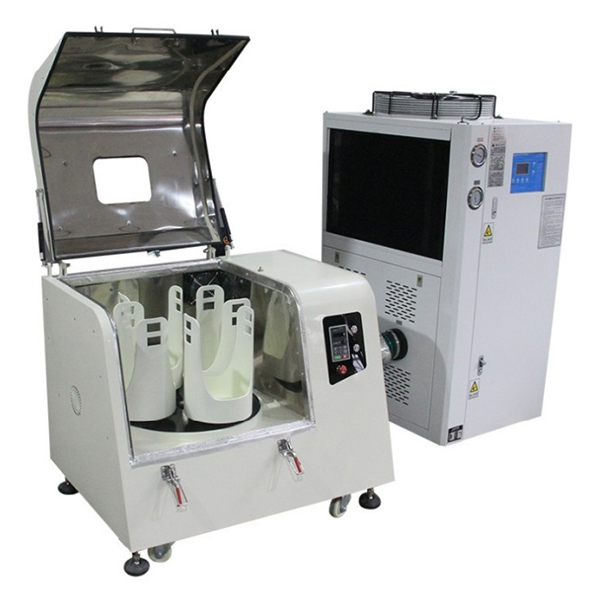


low temperature air cooled circulating planetary ball mill
Low temperature air cooled circulating planetary ball mill is a kind of laboratory equipment for fine grinding of materials in low temperature environment, which is suitable for grinding experiments of low temperature materials that are sensitive to temperature, easy to false welding, sticking to the wall and agglomeration.
Description
Low-Temperature Air-Cooled Circulating Planetary Ball Mill
Low-temperature air-cooled circulating planetary ball mill is designed for experiments and materials with temperature requirements, maintaining the sample material in a low-temperature state to prevent excessive heat and preserve its original properties. This air-cooled low-temperature ball milling method is essential for sensitive materials and experimental protocols.
Features
- The chiller adopts Panasonic compressor, stable quality, rapid refrigeration, the temperature in the chamber can be reduced to 1°C.
- Intelligent frequency conversion control, frequency setting temperature range 1 to 30°C.
- Adaptable to traditional vertical planetary ball mills and 360-degree rotary planetary ball mills.
- Can store 3 modes and 15 solutions.
- With power failure protection memory self-start function.
- The cavity uses heat preservation material to maintain a continuous low temperature environment, and automatically recovers cold air, greatly reducing operating costs.
- Oil seal mute technology: all planetary gears and bearings are sealed in an airtight box filled with lubricant before use, reducing gear noise by more than 50% compared to ordinary planetary ball mills and doubling service life.
- PLC frequency conversion control for time, speed, and forward/reverse settings.
- V type card holder secures the grinding jar, ensuring operator safety.
- Precision gear transmission.
- Can place 2 or 4 grinding jars at the same time.
- Supports dry grinding, wet grinding, vacuum grinding, and vacuum atmosphere protection grinding.
- Universal support feet and wheels for stability and easy movement.
- Intelligent control safety switch: door can only be opened when ball mill is stopped, preventing risk of jar ejection and protecting safety.
- Grinding effect can reach 0.1 micron.
- With CE certificate.
- Total timing range: 1 to 9999 minutes.
- Intermittent timing range: 1 to 9999 minutes.
- Continuous operation: up to 72 hours.
Cold Air Circulation Planetary Ball Mill Experiment Needs
- Maintain biological sample grinding temperature below 50°C.
- Prevent powder agglomeration during fine grinding.
- Ensure experimental synthesis temperature does not exceed 30°C.
- Prevent powder expansion and explosion risk at high temperatures during grinding.
Working Principle
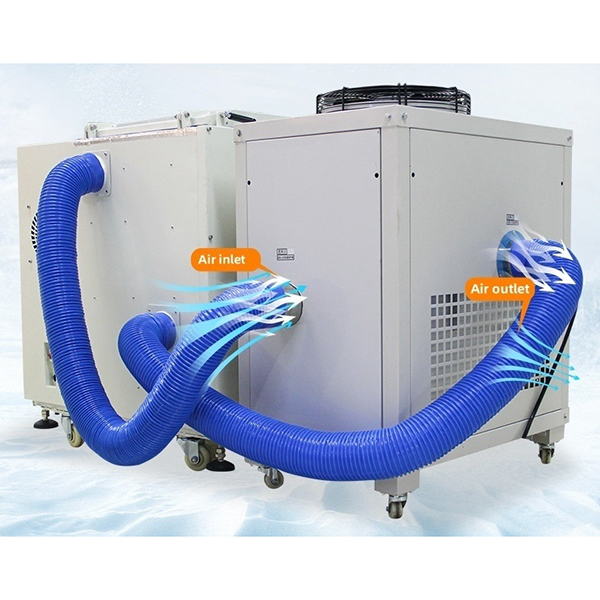
The grinding jar is mounted eccentrically on the sun wheel of the planetary ball mill. The sun wheel and the grinding jar move in opposite directions in a ratio of 1:2, and the grinding balls in the jar undergo superimposed rotational motion (Coriolis force). The speed difference between balls and jar creates friction and impact, releasing high kinetic energy for efficient size reduction. The chiller continuously supplies circulating low-temperature air to the chamber, keeping the sample in the grinding jar at low temperature.
Application Areas
- Agriculture: plant material, seeds, soil, tobacco, wood fiber
- Biological: bones, hair, tissue paper ceramics and glass ceramic oxides, clay minerals, glass, hydroxyapatite, china clay, quartz sand, electronic ceramics, structural ceramics, piezoelectric ceramics, nano-materials, round ceramic capacitors, MLCC, thermistors (PTC, NTC), ZnO varistors, dielectric ceramics, alumina ceramics, zirconium oxide ceramics, phosphor, zinc oxide powder, cobalt oxide powder, Ni-Zn ferrite, Mn-Zn ferrite chemicals and plastics, carbon fiber, catalysts, cellulose, pigments, paints, plastics, polymers
- Building materials: soap clay, cement slag, polymers, gypsum, sand, stone
- Environmental research: mixtures, electronic debris, sludge, waste
- Minerals, metallurgy, and metal electronics: alloys, coal, coke, iron ore, metal oxides, quartz, sub-precious stones, slag, magnetic materials, lithium cobaltate, lithium manganese, catalysts, phosphor, long afterglow luminescent powders, rare-earth polishing powders, electronic glass powders, fuel cells, zinc oxide piezoelectric resistors, etc.
Grinding Jars and Grinding Balls
- Grinding jars: refined mold or high-precision polishing, smooth inner/outer walls, large R angle bottom design to reduce material sinking, ergonomic grip for convenience.
- Jar materials: zirconia, silicon oxide, agate, carbide, stainless steel, high chrome steel, nylon, polyurethane, polypropylene pp, PTFE, aluminum oxide, etc.
- Jar volumes: 0.1L, 0.25L, 0.5L, 1L, 1.5L, 2L, 2.5L, 3L, 4L, 5L, 10L, 15L, 20L, 25L, etc.
- Grinding balls: zirconia ball, high chrome steel ball, stainless steel ball, corundum ball, polyurethane ball, alumina ball, onyx ball, tungsten carbide ball.
- Grinding balls typically match jar material; size range: 2mm to 50mm, recommended 3-4 different sizes in mixed proportions.
Technical Parameters
| Model | PM0.4L | PM1L | PM2L | PM4L | PM8L | PM12L |
|---|---|---|---|---|---|---|
| Grinding jar capacity | 50 to 100ml | 50 to 250ml | 50 to 500ml | 50 to 1000ml | 500 to 2000ml | 1000 to 3000ml |
| Vacuum jar capacity | 50ml | 50 to 100ml | 50 to 250ml | 50 to 500ml | 500 to 2000ml | 1000 to 3000ml |
| Revolution speed | 5 to 450rpm | 5 to 450rpm | 5 to 400rpm | 5 to 400rpm | 5 to 320rpm | 5 to 320rpm |
| Rotation speed | 10 to 900rpm | 10 to 900rpm | 10 to 800rpm | 10 to 800rpm | 10 to 640rpm | 10 to 640rpm |
| Power | 0.55kw | 0.55kw | 0.75kw | 0.75kw | 1.5kw | 1.5kw |
| Power supply | 220Vac, 50Hz | 220Vac, 50Hz | 220Vac, 50Hz | 220Vac, 50Hz | 220Vac, 50Hz | 380Vac, 50Hz |
| Weight | 68kg | 70kg | 96kg | 99kg | 191kg | 193kg |
| Dimensions | 600x400x500mm | 600x400x500mm | 780x580x680mm | 780x580x680mm | 800x600x750mm | 990x660x870mm |
| Model | PM16L | PM20L | PM40L | PM60L | PM80L | PM100L |
|---|---|---|---|---|---|---|
| Grinding jar capacity | 1 to 4L | 1 to 5L | 5 to 10L | 10 to 15L | 10 to 20L | 10 to 25L |
| Vacuum jar capacity | 1 to 4L | 1 to 5L | 5 to 10L | 10 to 15L | 10 to 20L | 10 to 25L |
| Revolution speed | 5 to 230rpm | 5 to 230rpm | 5 to 220rpm | 5 to 220rpm | 5 to 180rpm | 5 to 180rpm |
| Rotation speed | 10 to 460rpm | 10 to 460rpm | 10 to 440rpm | 10 to 440rpm | 10 to 360rpm | 10 to 360rpm |
| Power | 3kw | 3kw | 7.5kw | 7.5kw | 11kw | 11kw |
| Power supply | 380Vac, 50Hz | 380Vac, 50Hz | 380Vac, 50Hz | 380Vac, 50Hz | 380Vac, 50Hz | 380Vac, 50Hz |
| Weight | 230kg | 288kg | 400kg | 610kg | 1210kg | 1260kg |
| Dimensions | 990x660x870mm | 990x660x870mm | 1160x940x1450mm | 1160x940x1450mm | 1400x1100x1060mm | 1400x1100x1060mm |