


 English
  Français
  Tiếng Việt
  Italiano
  Nederlands
  Türkçe
  Svenska
  Polski
  Română
  Latviešu
  한국어
한국어  Русский
  Español
  Deutsch
  Українська
  Português
  العربية
  Indonesian
  Čeština
  Suomi
Suomi  Eesti
Eesti  Български
  Dansk
Dansk  Lietuvių
  Bokmål
  Slovenčina
  Slovenščina
  Ελληνικά
  Magyar
  עברית
עברית 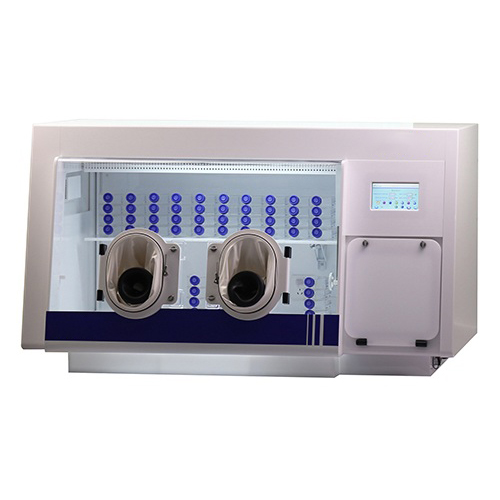
microaerobic workstation with two gloves for cultivation
Microaerobic, anaerobic workstation is a kind of professional experimental equipment integrating confined operation, atmosphere regulation, culture support and real-time monitoring.
Description
Microaerobic and anaerobic workstations are mainly used for microorganism inoculation, cultivation, transfer, medium change and observation in an anaerobic or low oxygen environment. The workstation is designed to provide experimental conditions for bacteria that are sensitive to oxygen or require a specific atmosphere for growth, and is an important tool for microbiology laboratories.
Features
- Wide applicability: can simultaneously meet the national standard requirements of a variety of anaerobic and microaerobic bacterial culture needs, such as Shigella (anaerobic, 41.5°C), Campylobacter jejuni (microaerobic, 25°C), Clostridium perfringens (anaerobic, 36°C), Clostridium botulinum (anaerobic, 35°C) and lactobacilli (anaerobic, 36°C) and so on.
- Strong sealing: the use of rigid cuffs with a long sleeve, to ensure that the operation process of the outside air can not enter, the experimental staff can be completely isolated from the state of oxygen operation.
- Complete module configuration: equipped with Petri dish racks, UV lamps, fluorescent lamps, power sockets, catalysts and decontamination and a series of components, power-on ready to use.
- Real-time monitoring system: built-in oxygen analyzer to realize continuous monitoring and safety control of oxygen concentration in the operation chamber.
- High operation convenience: equipped with wireless foot switch, supporting foot-controlled gas switching or vacuum extraction operation, improving the efficiency of use.
Core Advantages
- Accurate environmental control: through vacuum pump pumping, hydrogen and nitrogen mixed filling and catalytic deoxidation, it realizes oxygen concentration ≤ 0.1% and provides stable and reliable anaerobic/microaerobic environment.
- High degree of equipment integration: the whole machine integrates a variety of necessary components, no need for additional purchase, cost savings.
- Strong temperature adaptability: can be adapted to the conventional laboratory temperature (25°C) and high-temperature culture requirements, applicable to different strains of bacteria.
- Easy maintenance: supporting the provision of replaceable O-ring, catalyst, lubrication powder and other consumables to extend the service life.
- Safe and efficient: UV germicidal lamp and independent built-in socket to enhance the safety and electrical convenience, support long time continuous use.
Working Principle
- Gas replacement mechanism: through the vacuum pump first pump out the air in the operating chamber, and then filled with a mixture of nitrogen, hydrogen and carbon dioxide to replace oxygen.
- Chemical deoxygenation reaction: The catalyst bag contains highly efficient palladium catalyst, which makes hydrogen react with residual oxygen at room temperature to generate water vapor, thus further removing oxygen molecules.
- Sealing and Airtightness Maintenance: Designed with high-strength gloves and O-ring seals, the purity and stability of the internal atmosphere will not be damaged during any operation.
In addition, the oxygen analyzer monitors the oxygen concentration changes in the environment in real time, and prompts the user through the feedback mechanism whether the gas needs to be replaced again to ensure that the quality of the environment meets the requirements.
Working Conditions
- Power requirements: 220V AC, 50/60Hz
- Rated current: 4A
- Use environment: room temperature 25°C, relative humidity <90%, suitable for routine laboratory environment
Standard Configuration List
- Host: 1 set.
- Vacuum pump: 1 set.
- Oxygen analyzer: 1 set.
- Long cuff: 1 pair.
- Rigid cuff: 1 pair.
- O-rings (for wrist): 2 pairs.
- O-rings (for long cuffs): 1 pair.
- Wireless foot switch: 1 pc.
- Petri dish rack: 8 pcs.
- Fluorescent lamp: 1 pc.
- Ultraviolet lamp: 1 pc.
- Catalyst (200g): 3 bags.
- Deoxidizer (Regulator, 200g): 3 bags.
- Lubricating powder: 1 bottle.
- Internal power sockets: 2 pcs.
- Power cord: 1 pc.
- Operation manual and installation accessories: 1 set.
Typical Application Areas
- Medical microbiology laboratory: for cultivation and analysis of enteropathogenic bacteria, trauma infection bacteria and other pathogens that require anaerobic conditions.
- Food fermentation and probiotic research and development: for example, industrial domestication and strain optimization of probiotics such as lactobacilli and bifidobacteria.
- Clinical pathology testing: drug resistance testing and virulence analysis under anaerobic conditions.
- Environmental microbiology research: used to simulate anaerobic ecosystems such as sewage sedimentary layer, biogas fermentation and other environments.
- Drug development and intestinal flora research: study the impact of drugs on intestinal microecology, the dynamic response of anaerobic bacterial populations.
Technical Parameters
Model: AM50G
- Equipped with built-in fast transfer gate, capacity 23 liters, transfers 60 x 90mm dishes at once. Transfer gate internal dimensions (W x H x D): 290 x 250 x 320mm; gate door dimensions: 250 x 250mm. N₂ blowing wash completes sample/equipment transfer in 60 seconds, either into or out of the workstation.
- The inner door of the transfer bin adopts mechanical press door lock to ensure airtightness during rinsing.
- One-handed single-key operation for inner door of the transfer gate; easy and convenient.
- Capacity: holds 900 x 90mm dishes.
- Removable side panels for equipment access and box cleaning. Cleaning uses special workstation disinfectant: tetrasodium EDTA + 3-tert-butylphenol lauryl polyoxyethylene ether sodium sulfate mixture (effective cleaning & sterilization without box damage).
- Gas supply: single gas (oxygen-free mixture: 80% N₂ + 10% H₂ + 10% CO₂); double gas (one bottle pure nitrogen, one bottle oxygen-free mixture).
- Parameter setting, equipment status monitoring & alarm via 7-inch color touch screen.
- Equipped with ultrasonic humidification & fully automatic humidity control system; humidity range: ambient to 90%.
- Standard fluorescent lamp, 254nm ultraviolet sterilization lamp.
- Optional built-in HEPA U16 filter; filtration efficiency ISO14644-1 class 3, with test reports.
- Standard high-precision oxygen indicator for real-time oxygen concentration display.
- High anaerobic degree: oxygen concentration <50ppm, with measured photos, on-site acceptance.
- Temperature: control range room temperature +3°C to 52°C, display accuracy 0.1°C, deviation ±0.3°C, with test report.
- Long sleeve bare hand operation; sleeve system fills with nitrogen under vacuum, ensuring 100% oxygen removal before entry.
- Wireless foot switch controls vacuum & nitrogen filling; comes standard with external vacuum pump.
- Standard with 2 built-in power sockets.
- Data logging: USB interface, records temperature, humidity, air intake time, up to 30 days; provides software screenshots.
- Alarm system includes: high/low temperature, humidity out of range, anaerobic mixing gas, nitrogen low-pressure, gas leakage alarms. Automatic gas overcurrent protection: continuous air intake >5 min, inlet solenoid valve automatically shuts down. Provides screenshots.
- Timed air intake system: time can be set/displayed on touch screen; fast mode time also set/displayed, with screenshots.