


 English
  Français
  Tiếng Việt
  Italiano
  Nederlands
  Türkçe
  Svenska
  Polski
  Română
  Latviešu
  한국어
한국어  Русский
  Español
  Deutsch
  Українська
  Português
  العربية
  Indonesian
  Čeština
  Suomi
Suomi  Eesti
Eesti  Български
  Dansk
Dansk  Lietuvių
  Bokmål
  Slovenčina
  Slovenščina
  Ελληνικά
  Magyar
  עברית
עברית 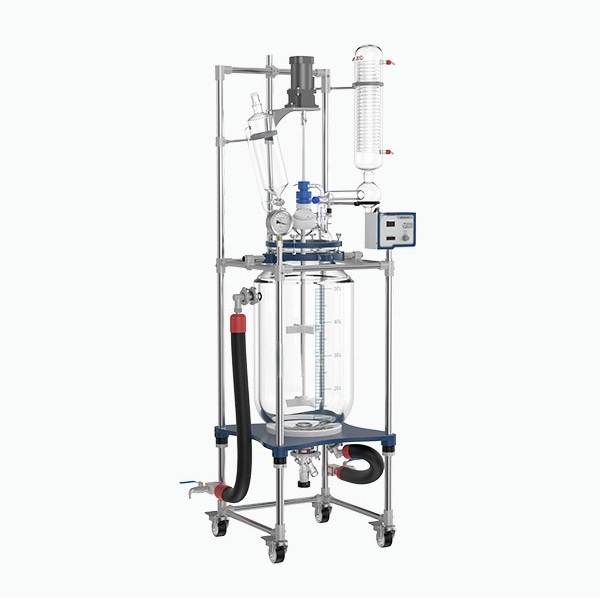
pilot-scale glass reactor with adjustable speed and heating
Pilot-scale glass reactor is a multifunctional reaction system designed for reaction process amplification and process optimization, which is widely used in the fields of new material synthesis, drug development, chemical pilot test and natural product extraction.
Description
Pilot-Scale Glass Reactor
The pilot-scale glass reactor is designed for precise control of temperature, pressure, and stirring in scale-up chemical processes. Serving as a bridge between laboratory research and industrialized production, this equipment is ideal for pharmaceutical, chemical, bioengineering, materials, and environmental applications.
Main Features
- Reaction Vessel: Made of 3.3 borosilicate glass for superior thermal shock resistance and acid/alkali corrosion resistance, ensuring long-term safe operation.
- Wide Working Conditions: Temperature range from -80°C to 200°C; pressure range from 0 to -0.1MPa, suitable for low-temperature synthesis and decompression reactions.
- Optimized Pipeline Design: Jacket interface uses stainless steel insulated hoses to prevent interface stress damage from thermal cycling.
- High Sealing Stirring System: Sealed bearings ensure smooth operation and prevent impurity entry into the reaction system.
- Anticorrosive Components: PTFE stirring blades and PTFE-coated stainless steel shaft combine mechanical strength and chemical stability.
- Movable Bracket: Stainless steel and aluminum alloy spray frame, neat and corrosion-resistant, with brake wheels for easy positioning and cleaning.
- Safe Discharge Design: Inclined, non-accumulating discharge valve at the top reduces residue, simplifies collection and post-processing.
- Convenient Data Monitoring: Digital display and vacuum gauge for real-time temperature, stirring speed, and system pressure monitoring.
- Structural Protection: External circulation pipe fixed to frame, avoiding glass interface stress and extending service life.
Working Principle
- Double-layer jacket allows heat/cold source (thermal oil, water, ethanol) to circulate, controlled by external thermostat; insulated hose connections prevent glass stress for stable temperature control.
- Motor-driven stirring shaft creates effective mixing, solid suspension, and uniform heat transfer; blade shapes selectable for different fluid characteristics; pressure monitored by vacuum gauge for vacuum or atmospheric operation.
- Inclined bottom discharge port enables smooth, residue-free material discharge and easy cleaning after reaction.
Application Areas
- Pharmaceutical Industry: API synthesis, crystal screening, impurity reaction assessment.
- Fine Chemical Industry: Development of flavors, dyes, additives, catalysts, high-value products.
- Organic Synthesis Research: Condensation, cyclization, redox, coordination reactions.
- Bioengineering: Enzyme reactions, cell extraction, optimization of organic acid or polysaccharide synthesis.
- New Material Development: Synthesis of nanoparticles, polymers, MOFs, and high-performance materials.
- University Research Platform: Reaction process scale-up, pilot demonstrations, teaching.
- Environmental Engineering: Reactivity testing, water treatment additive optimization, experimental program development.
Technical Parameters
| Model | TR-10 | TR-10Ex | TR-20 | TR-20Ex | TR-50 | TR-50Ex |
|---|---|---|---|---|---|---|
| Vessel volume | 10L | 20L | 50L | |||
| Jacket volume | 8L | 3L | 9L | 6L | 13L | 16L |
| Funnel volume | 1.0L | 2.0L | 2L | |||
| Operating pressure | Ordinary or negative pressure | |||||
| Working temperature | -80°C to 200°C | |||||
| Condenser cooling area | 0.234 square meters | 0.341 square meters | 0.265 square meters | 0.429 square meters | ||
| Stirring speed | 20rpm to 500rpm | 50rpm to 500rpm | 20rpm to 500rpm | 50rpm to 500rpm | 20rpm to 500rpm | 50rpm to 500rpm |
| Power supply | 100-240V, 50/60Hz | 220-240V, 50/60Hz | 100-240V, 50/60Hz | 220-240V, 50/60Hz | 100-240V, 50/60Hz | 220-240V, 50/60Hz |
| Drain port, ground clearance | 320mm | 320mm | 355mm | 320mm | ||
| Dimensions(WxDxH) | 845x640x1780mm | 845x640x1910mm | 870x580x1910mm | 900*690*2100mm | 900x690x2050mm | |
| Model | TR-100 | TR-100Ex |
|---|---|---|
| Vessel volume | 100 L | |
| Jacket volume | 25 L | 30L |
| Feeding flask volume | 10 L | |
| Receiving flask volume | 20 L | |
| Glass material | High borosilicate glass 3.3 | |
| Frame and connection parts material | SUS304 + aluminum plate spraying | SUS304 |
| Operating pressure | Ordinary or negative pressure | |
| Working temperature | -80°C to 200°C | |
| Condenser cooling area | 0.954 square meters | |
| Stirring speed | 20rpm to 500rpm | 50rpm to 500rpm |
| Power supply | 100-240V, 50/60Hz | 220-240V, 50/60Hz |
| Drain port ground clearance | 340mm | |
| Dimensions(WxDxH) | 1270x810x2360mm | 1200x790x2360mm |