


 English
  Français
  Tiếng Việt
  Italiano
  Nederlands
  Türkçe
  Svenska
  Polski
  Română
  Latviešu
  한국어
한국어  Русский
  Español
  Deutsch
  Українська
  Português
  العربية
  Indonesian
  Čeština
  Suomi
Suomi  Eesti
Eesti  Български
  Dansk
Dansk  Lietuvių
  Bokmål
  Slovenčina
  Slovenščina
  Ελληνικά
  Magyar
  עברית
עברית 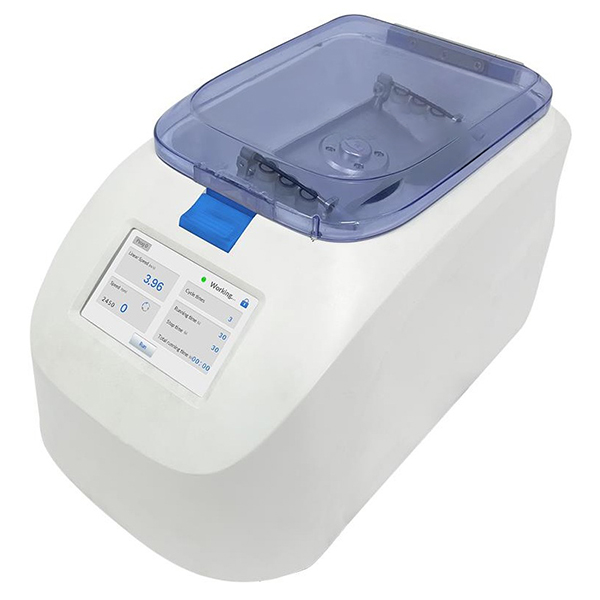
six position homogenizer that eliminates cross-contamination
This six position homogenizer is suitable for 2.0mL and 5.0mL screw cap tubes, and can complete the homogenization process from cells to hard tissues, such as bones, in about 45 seconds, which is widely used in the fields of molecular biology, medical testing, drug discovery and material science.
Description
Six Position Homogenizer
With high-frequency three-dimensional vibration and a special bead system, the six position homogenizer can rapidly perform lysis, grinding, and homogeneous mixing, making it ideal for medium-throughput laboratories seeking efficient, low-contamination sample fragmentation and extraction.
Main Features
- High-throughput sample processing: homogenize up to 6 samples at once, greatly increasing efficiency over traditional tissue grinding.
- Intelligent touch control: color touchscreen interface supports parameter programming and memory, making operation simple and intuitive.
- Flexible, adjustable rotation speed: set speed, time, and cycle according to sample type for different lysis needs.
- Safety protection: automatic shutdown when cover is opened to prevent accidents or misoperation.
- Quiet, smooth operation: imported bearings and shock-absorbing structure keep noise low and enable use in any lab environment.
- Compact, space-saving: only 360 mm wide, easily fits on standard lab tables.
- Diversified support: compatible with 2.0 mL and 5.0 mL tubes for a range of sample volumes.
- Prevents cross contamination: independent sealed tube system completely avoids cross interference between samples.
Working Principle
The homogenizer uses a three-dimensional orbital vibration mechanism, subjecting samples to complex vibration in X, Y, and Z directions. This causes microbeads inside the tube to follow highly irregular, high-frequency impact paths. The resulting shear, squeeze, and impact forces between beads and sample efficiently break cell membranes or tissue structures, enabling cell lysis and the release of RNA, DNA, proteins, etc.
Different bead materials and sizes (stainless steel, zirconium oxide, glass, etc.) can be selected based on sample hardness and experimental requirements. The sealed tube process simplifies usage: load sample and beads, homogenize, then centrifuge to collect the cleavage products.
Application Areas
- Molecular biology: rapid extraction of RNA, DNA, or protein from animal/plant tissues, microorganisms, eukaryotic cells, etc.
- Pharmacology and toxicology: grinding drug tissue models, animal organs, and drug delivery systems.
- Forensic science and clinical testing: processing trace samples (nails, hair, dried blood) for forensic genetic material extraction.
- Environmental science and soil analysis: grinding plant roots, sediments, water microbe samples for target biomolecule extraction.
- Food and agricultural testing: detection of GMOs or microbial contamination in fruits, vegetables, grains, seeds, etc.
- Materials science and mineral research: pretreatment analysis of soft ores or biomineral composites.
Technical Parameters
| Model | D200 |
|---|---|
| Capacity | 6x2.0ml or 2x5ml |
| Timer | 3 second to 3 minutes |
| Speed range | 2450rpm to 4450rpm |
| Discharge size | about µm |
| Grinding ball diameter | 0.1 to 5mm |
| Acceleration time | Within 2 seconds |
| Deceleration time | 2 seconds |
| Grinding method | Wet grinding, dry grinding |
| Safety Protection | Emergency stop for opening the lid |
| Power | 250W |
| Power supply | 230Vac, 50/60Hz |
| Dimensions | 360mmX220mmX210mm |
| Weight | 9kg |