


 English
  Français
  Tiếng Việt
  Italiano
  Nederlands
  Türkçe
  Svenska
  Polski
  Română
  Latviešu
  한국어
한국어  Русский
  Español
  Deutsch
  Українська
  Português
  العربية
  Indonesian
  Čeština
  Suomi
Suomi  Eesti
Eesti  Български
  Dansk
Dansk  Lietuvių
  Bokmål
  Slovenčina
  Slovenščina
  Ελληνικά
  Magyar
  עברית
עברית 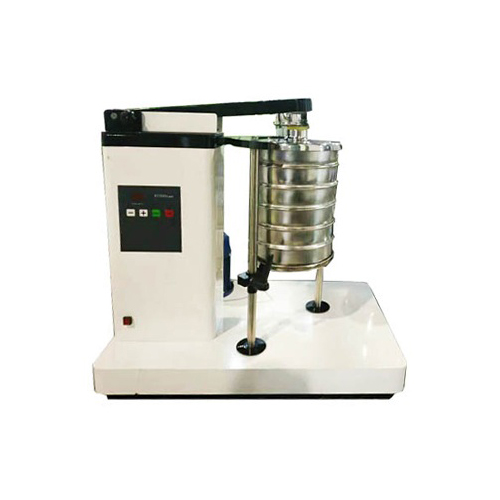
tap sieve shaker for the military and chemical industries
By simulating manual sieving action and combining circular motion with vertical clapping, the clapper sifter is capable of standardized automatic sieving of powder and granular samples, and is the recommended sieving equipment in accordance with a number of international standards, such as ISO and ASTM.
Description
Tap Sieve Shaker
The Tap Sieve Shaker is an efficient and accurate dry particle analysis instrument designed for laboratory and quality inspection applications in particle classification, particle size determination, and sieve analysis. Ideal for irregular, agglomerating, and friction-prone samples, this device is widely used in metallurgy, geology, pharmaceuticals, building materials, chemicals, food, soil testing, and more.
Features
- Dual motion mode: Integrates circular translation and vertical tapping action to replicate manual screening, suitable for complex particle samples.
- Strong sieving consistency: Fixed movement frequency and stable mechanical structure ensure highly repeatable sieving experiments.
- Multi-layer sieve frame support: Accommodates up to 7 layers of standard analytical sieves (200 mm or 8-inch diameter) for rapid and efficient classification.
- Easy operation: Precise digital panel for sieving time settings, one-button start for standardized testing.
- Durable structure: Maintenance-free AC motor drive and robust anti-vibration body for long service life.
- Safety and security: Equipped with safety switch and anti-jamming system for reliable operation.
- Low noise operation: Optional soundproof cabinet, suitable for continuous laboratory use.
Working Principle
Driven by a motor, the sieve frame platform moves in a horizontal circular motion, simulating manual sieving, while vertical tapping action replicates manual flapping. This dual force ensures thorough particle separation: larger particles remain on the screen, while finer particles pass through to lower screens. The tapping action is switchable to suit different sample properties, and precise control of sieving time and movement frequency guarantees accurate, reproducible results.
Application Areas
- Geology and minerals: Particle size analysis and grading after ore crushing, soil particle screening.
- Building materials industry: Particle size control for cement, lime, sand, gravel, and related raw materials.
- Pharmaceutical industry: Consistency testing of powder particles, granule quality control.
- Food industry: Dry powder screening and grading for products like flour and powdered sugar.
- Chemical industry: Particle size assessment for pigments, catalysts, additives, and powders.
- Environmental protection and agriculture: Screening of contaminated soils and fertilizer particle analysis.
Technical Parameters
| Model | AS200tap |
|---|---|
| Number of screen layers | 1 to 7 |
| Sieve diameter | 200mm, 203mm, 8inch |
| Sieve size | 20μm to 25mm |
| allowable load | ≤3kg |
| Oscillations per minute | 278 ± 10 |
| Taps per Minute | 150 ± 10 |
| Tap height | 38 ± 6mm |
| Oscillations displacement | 25mm |
| Timer | 1s to 99minutes |
| Noise | less than 82db |
| Power supply | 220Vac, 50Hz |
| Power | 180W |
| Dimensions | 700x450x650mm |
| Weight | 68kg |
| Measuring range | 20μm to 30mm |
| Amplitude | 0 tp 3mm continuously adjustable |
| Dry and wet sieving | yes |
| Intermittent operation | 0 to 99s |
| Sample load | 3kg |
| Number of analyzing sieve stages | 9 stages |
| Sieve material | stainless steel |
| Diameter of sieve | 100, 150, 200, 203mm, 8" |
| Movement form | three-dimensional throwing movement |
| Power supply | 220Vac, 50Hz |
| Power | 400W |
| Net weight | 43kg |
| Dimensions | 400x480x240mm |
| Note: | Sieve shaker is made in China, but all sieves are made in european and the USA. Our sieves standards are available in ASTM E11 and ISO 3310 for users to choose from. |