


 English
  Français
  Tiếng Việt
  Italiano
  Nederlands
  Türkçe
  Svenska
  Polski
  Română
  Latviešu
  한국어
한국어  Русский
  Español
  Deutsch
  Українська
  Português
  العربية
  Indonesian
  Čeština
  Suomi
Suomi  Eesti
Eesti  Български
  Dansk
Dansk  Lietuvių
  Bokmål
  Slovenčina
  Slovenščina
  Ελληνικά
  Magyar
  עברית
עברית 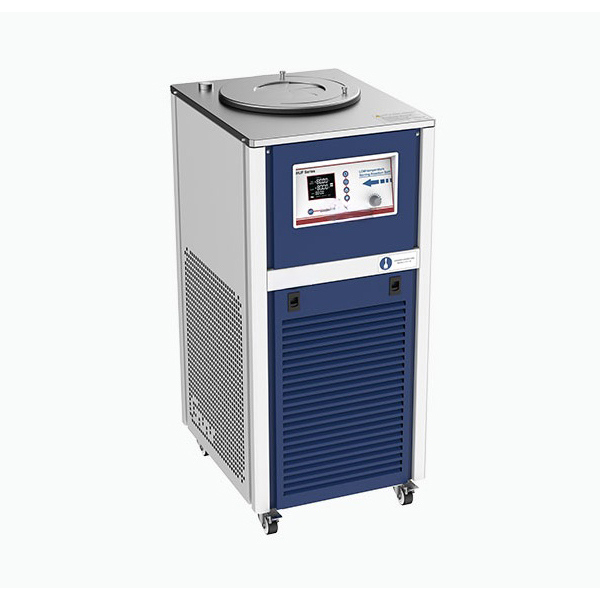
ultra low temperature stirring bath for chemical reaction
Ultra low temperature stirring bath is a precision temperature control reaction system, suitable for -80°C to +99°C wide temperature zone regulation, can realize the reaction system at a specific temperature stable stirring, cooling and heating control.
Description
Ultra Low Temperature Stirring Bath
The ultra low temperature stirring bath integrates compressor refrigeration, constant temperature heating, powerful circulation, and intelligent control. It is a temperature control device for experimental and pilot processes in chemistry, pharmaceuticals, new materials, and more. Air-cooled design ensures energy saving, environmental protection, and suitability for long-term use in laboratories and clean rooms.
Main Features
- Wide Temperature Control Range: Accurate control from -80°C to +99°C for ultra-low temperature reactions, heat-sensitive operations, and thermostatic testing.
- Air-cooled, Energy-saving Design: Air-cooled condenser eliminates the need for external cooling water, simplifying operation.
- Modular Structure: Integrated refrigeration, heating, circulation, and control modules in a compact, stable system.
- All Stainless Steel Liquid Parts: Liquid tank, evaporator, pipelines, and pump made of 304 stainless steel for corrosion resistance and ultra-low temperature adaptability.
- High-performance Compressor: Taikang sealed piston compressor ensures stable and efficient refrigeration.
- Intelligent Program Temperature Control: Supports multi-stage program settings and flexible temperature strategies for complex profiles.
- LCD Operating Panel: Color display with clear parameter visibility and user-friendly operation.
- Comprehensive Safety Protection: Overload, over-temperature, and delayed start mechanisms keep operation safe and reliable.
Working Principle Analysis
-
- Refrigeration Mechanism: Compressor compresses refrigerant, which is condensed, expanded, and evaporated to quickly cool the coolant; evaporator submerged in liquid tank ensures rapid temperature balance.
- Heating Mechanism: Stainless steel tubular electric heater enables rapid, uniform warming and precise temperature rise rates.
- Circulation System: Ultra-low temperature pump circulates coolant or thermostatic liquid to reaction vessels/jackets, maintaining a stable, uniform temperature environment.
- Control System: PID adaptive algorithm and multi-segment program editing enable complex temperature change controls (constant, cooling curve, heating platform) for process simulation and research.
Application Areas
- Organic chemistry experiments: Grignard, low-temp redox, coupling reactions, etc.
- Pharmaceutical process development: API/intermediate synthesis, crystallization steps.
- Materials engineering: Polymer synthesis, resin modification, nanoparticle prep with stable stirring and temperature control.
- Battery & energy materials R&D: Electrolyte and diaphragm material low-temp testing or pretreatment.
- Food & biotechnology: Natural product extraction, enzyme activity, low-temp sterilization.
- Analysis & testing: Stable constant temperature medium for densitometers, viscometers, UV spectroscopy, and more.
Technical Parameters
| Model | RB20-5 |
|---|---|
| Bath volume | 5L |
| Temperature range | -80°C to +99°C |
| Temperature stability | ±0.2°C |
| Heater rating power | 1500W |
| Overall power | 3260W |
| Cooling method | air cooling |
| refrigerants | R404A, R23 |
| cooling power | 350W at -40°C, 260W at -60°C, 80W at -80°C |
| Circulation pump Flow rate | 20L per minute |
| Circulation pump Pressure | 0.4bar |
| Environmental temperature | 5°C to 35°C |
| protection class | IP20 |
| Power supply | 220 to 240Vac, 50Hz |
| Outer Circulation Interface | RC1/2 |
| Bath opening size | diameter 210mm |
| Bath size | diameter 250x160mm |
| Flask volume | 2L |
| contamination level | 2 |
| Overall dimensions | 455Wx585Dx1025H mm |
| Weight | 100kg |