


 English
  Français
  Tiếng Việt
  Italiano
  Nederlands
  Türkçe
  Svenska
  Polski
  Română
  Latviešu
  한국어
한국어  Русский
  Español
  Deutsch
  Українська
  Português
  العربية
  Indonesian
  Čeština
  Suomi
Suomi  Eesti
Eesti  Български
  Dansk
Dansk  Lietuvių
  Bokmål
  Slovenčina
  Slovenščina
  Ελληνικά
  Magyar
  עברית
עברית 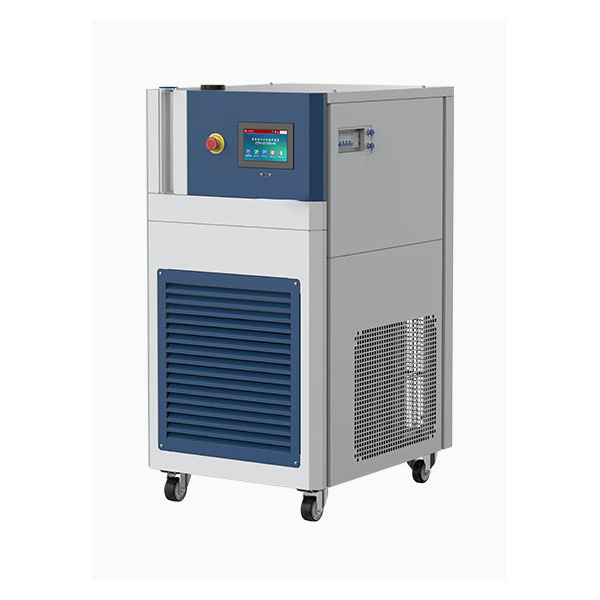
circulation heating thermostat with cooling function
Circulation heating thermostat has the function of rapid refrigeration and high-efficiency heating, and transports temperature control medium, such as heat-conducting oil or coolant to the external equipment through the closed-circuit circulation method to realize precise temperature control.
Description
Circulation Heating Thermostat
The circulation heating thermostat integrates refrigeration, heating, circulation pump group, and intelligent control module, with options for air-cooled or water-cooled cooling methods. It is ideal for high-precision thermal management in applications such as reaction kettle temperature control, new material testing, chip heat treatment, and industrial process temperature regulation. Stable operation from -40°C to +200°C, PID program temperature control, data export, and remote communication functions meet the needs of automated production and scientific research.
Core Features
- Wide-temperature operation capability: Covers -40°C to +200°C, suitable for low-temperature gel reactions and high-temperature cracking.
- Highly integrated modular structure: Integrates cooling, heating, circulation, and control systems in one compact, efficient unit.
- Flexible cooling mode: Supports air-cooled and water-cooled condenser forms; users select based on site conditions.
- High-definition touch screen control: 7-inch true color touch screen, intuitive operation, data curve display, and operation record function.
- Program temperature control ability: Supports 120 groups of temperature control programs, each with 100 temperature segments, allowing linear and gradient temperature rise and fall.
- Automatic protection mechanisms: Over-temperature, over-current, overload, delayed start, high-voltage protection, and more for safe operation.
- Remote communication and integration: RS485 interface compatible with MODBUS RTU, connectable to upper systems (DCS, SCADA) for centralized control.
- Expansion vessel design: Built-in expansion vessel and liquid level monitoring automatically respond to heat-carrying medium volume changes, ensuring stable circulation.
- Wide adaptation to heat conduction mediums: Supports water, ethanol, silicone oil, and other fluids for diverse application requirements.
System Principle
- Refrigeration Principle: Built-in rolling rotor hermetic compressor rapidly cools the heat-carrying body via condenser, capillary throttling, and plate evaporator. Plate heat exchanger is compact and efficient. Air-cooled type uses finned condenser; water-cooled uses coaxial heat exchanger.
- Heating Principle: Special flange-type electric heater for thermal oil provides high power density and fast response, ensuring uniform temperature distribution.
- Circulation and Expansion Mechanism: Shielded pump suitable for high/low temperatures delivers continuous medium flow. 304 stainless steel piping with insulation prevents heat loss/corrosion. Expansion vessel absorbs volume fluctuations; liquid level monitor ensures stable operation.
- Control Logic: PID algorithm adjusts temperature output in real time, supports temperature curve setting, fixed-value, and program control. Software supports data recording, curve display, USB export, and remote communication.
Application Areas
- Chemical and pharmaceutical reaction temperature control: High-precision synthesis, crystal culture, drug intermediate control.
- New energy materials development: Batteries, superconducting materials, carbon nanotubes thermal cycle testing.
- Semiconductor and electronic component testing: Rapid thermal stress testing for chips, circuit boards.
- Vacuum system thermal control support: Works with vacuum drying, condensation recovery, and related equipment.
- Aerospace simulation testing: Test component performance under changing temperature environments.
- University and scientific research experiments: Provides high-precision temperature control for research platforms and reliable experiments.
Technical Parameters
| Model | HC10-4(W) | HC10-10(W) | HC10-12(W) |
|---|---|---|---|
| Temperature range | -40°C to +200°C | ||
| Temperature stability | ±0.5°C | ||
| Overall power | 5.7kw | 11.1kw | 18.6kw |
| Cooling power at 200°C | 3kw | 6kw | 12kw |
| Cooling power at 100°C | 3kw | 6kw | 8.6kw |
| Cooling power at 25°C | 2.4kw | 4.5kw | 5.8kw |
| Cooling power at -10°C | 1.4kw | 4.2kw | 4.5kw |
| Cooling power at -20°C | 1.2kw | 3.2kw | 3.5kw |
| Cooling power at -30°C | 0.85kw | 2kw | 2kw |
| Cooling power at -40°C | 0.25kw | 1.1kw | 1.1kw |
| Heater Rated Power | 3kw | 6kw | 12kw |
| Cooling method | air cooling or water cooling | ||
| refrigerants | R404A | ||
| Circulation pump Flow rate | 30L per minute | 45L per minute | |
| Circulation pump Pressure | 1bar | 1.4bar | |
| Circulation Interface Size | R3/4 | ||
| Maximum viscosity of heat-carrying medium | 30cp | ||
| Noise level | 65db | ||
| communication interface | usb, RS485 | ||
| protection class | IP20 | ||
| contamination level | 2 | ||
| Environmental temperature | 5°C to 35°C | ||
| Power supply | 380Vac, 50Hz, 3 phase | ||
| Current | 10.5A | 20A | 33A |
| Electrical Connection Methods | three-phase four-wire system | ||
| External dimensions | 640Wx860Dx1270H mm | 750Wx1100Dx1420H mm | 750Wx1100Dx1420H mm |
| Weight | 205kg | 330kg | 360kg |