


 English
  Français
  Tiếng Việt
  Italiano
  Nederlands
  Türkçe
  Svenska
  Polski
  Română
  Latviešu
  한국어
한국어  Русский
  Español
  Deutsch
  Українська
  Português
  العربية
  Indonesian
  Čeština
  Suomi
Suomi  Eesti
Eesti  Български
  Dansk
Dansk  Lietuvių
  Bokmål
  Slovenčina
  Slovenščina
  Ελληνικά
  Magyar
  עברית
עברית 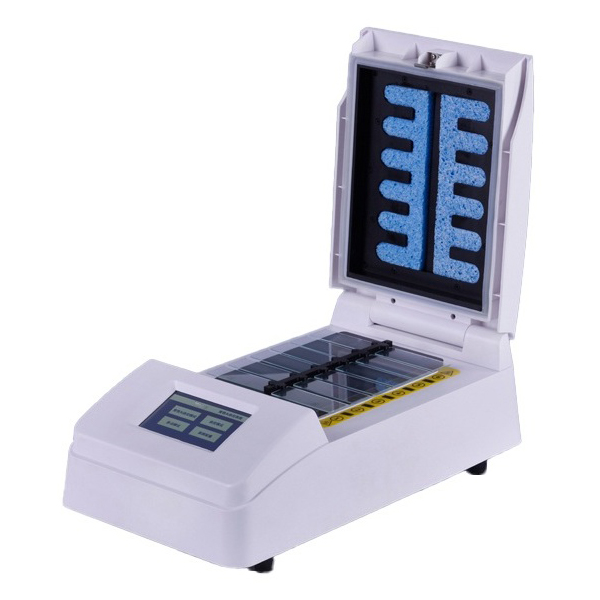
hybridization system that can handle up to twelve slides
hybridization system is a high-precision experimental equipment dedicated to the detection of nucleic acid DNA or RNA in cell and tissue sections, which integrates denaturation, hybridization and amplification, and is widely used in the fields of pathology, molecular biology, clinical diagnosis and so on.
Description
Hybridization System
This system ensures high specificity and reproducibility for hybridization reactions by precisely controlling temperature, humidity, and time. It is an essential platform for experiments such as fluorescence in situ hybridization (FISH), in situ PCR, and RNA in situ hybridization.
Features
- Full-color Touch Screen Control: Intuitive operation; interface supports Chinese and English switching for versatile lab use.
- Intelligent Program Control: Stores and recalls up to 105 custom programs, supporting diverse experimental needs.
- Precise Platform Temperature Control: Accuracy up to ±0.1 °C; efficient heating for rapid and uniform warming.
- Automatic Humidification & Sealing: Built-in humidifier and closed lid prevent sample drying and enhance reaction efficiency.
- Multi-tasking Parallel Processing: Processes up to 12 standard slides at once, boosting experimental throughput.
- Power Failure Design: Recovery function allows continuation from interruption point after power is restored, avoiding data loss.
- Intelligent Preheating & Automatic Cooling: Programmable preheating and post-experiment auto-cooling for safety and user experience.
- Multi-mode Operation: Supports “denaturation + hybridization”, “hybridization”, “in situ PCR”, and other modes.
Core Advantages
- High Stability & Consistency: Advanced PID temperature control technology ensures uniform temperature distribution and high reproducibility.
- Labor-saving, High Throughput: Handles multiple samples simultaneously—reduces manual operation, ideal for batch work in medium and large labs.
- Flexible Application Expansion: Multi-purpose compatibility with various processes and staining methods for broad research and clinical support.
- High Degree of Automation: Intelligent logic control system minimizes operator intervention and risks.
Working Principle
- Sample Heating & Denaturation: High temperature separates DNA double strands, preparing single strands for probe hybridization.
- Constant Temperature Hybridization: Maintains optimal temperature and humidity for specific probe-target binding.
- Integrated Processing: Automatically carries out denaturation, hybridization, and in situ PCR within a closed environment, minimizing interference and maximizing specificity and stability.
Application Fields
- Medical Pathology: Tumor marker detection (e.g., HER2), chromosome abnormality analysis, pathogen localization.
- Molecular Genetics Research: Target sequence detection and localization in gene expression and chromosome studies.
- Clinical Molecular Diagnosis: HPV detection for cervical cancer, genetic disease screening, PGD.
- Animal & Plant Research: RNA in situ hybridization, tissue-specific gene expression analysis.
- Precision Medicine & Personalized Treatment: Quantitative support for drug target screening and efficacy monitoring.
Technical Parameters
| Model | SH10 |
|---|---|
| Temperature range | ambient+5°C to 100°C |
| Temperature resolution | 0.1°C |
| Temperature accuracy | ≤±1°C, at 37°C |
| Temperature uniformity | ≤±1°C, at 37°C |
| Temperature rise time | ≤2 minutes, 37°C to 95°C |
| Reduced temperature time | ≤6 minutes, 95°C to 45°C |
| Sample volume | 12 pieces |
| Timer | 1 minute to 99 hours 59 minutes or continuous |
| Power supply | 220Vac, 50-60Hz or 110Vac, 50-60Hz |
| Power | 350W |
| External dimensions | 440x220x120mm |
| Weight | 4.5kg |