


 English
  Français
  Tiếng Việt
  Italiano
  Nederlands
  Türkçe
  Svenska
  Polski
  Română
  Latviešu
  한국어
한국어  Русский
  Español
  Deutsch
  Українська
  Português
  العربية
  Indonesian
  Čeština
  Suomi
Suomi  Eesti
Eesti  Български
  Dansk
Dansk  Lietuvių
  Bokmål
  Slovenčina
  Slovenščina
  Ελληνικά
  Magyar
  עברית
עברית 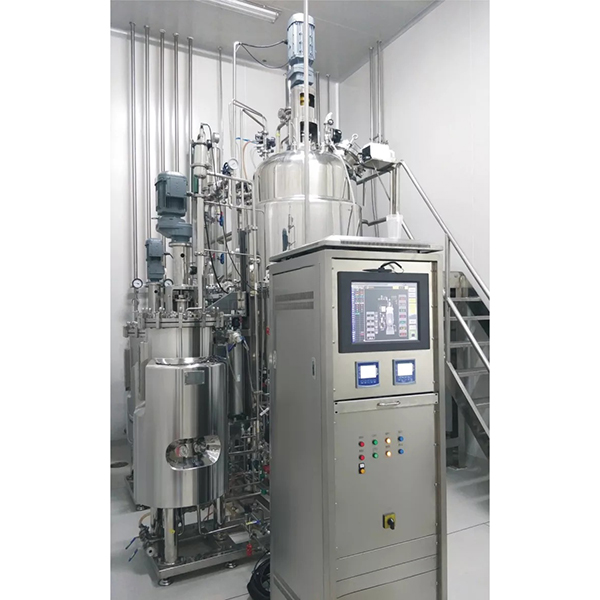
pilot-scale fermenter system for food fermentation industry
Pilot-scale fermenter system is mainly used in the transition stage between laboratory and industrial production, suitable for the research and development of biological products, process optimization and pilot scale-up.
Description
Pilot Scale Fermenter System
The pilot scale fermenter system simulates production conditions to support process development, data acquisition, and scalability for large-scale manufacturing. With advanced control modules and flexible configuration, it ensures stable, efficient, and traceable fermentation for pharmaceuticals, food, bioenergy, environmental, agricultural, and chemical industries.
Main Features
- Size & Ratio: Diameter-to-height ratio (1:2–1:3) enhances gas dissolution and mixing, avoids dead spots and sediment.
- Mechanical Stirring: Stepless speed regulation (50–1000rpm), adjustable paddle height for precise mixing.
- Magnetic Stirring: Top/bottom drive for aseptic culture, reduces contamination risk, ideal for sensitive organisms.
- Sterilization: In-situ sterilization for operational sterility; autoclave sterilization for glass bioreactors.
- Intelligent Control: Self-developed software supports PID adjustment, parameter setting, monitoring, data storage, and remote control.
- Temperature & pH Control: Electric heating/water cooling, 5–60°C range, PID adjustment; pH controlled via peristaltic pump, automated alarms.
- Dissolved Oxygen: DO control accuracy ±3%, range 0–150%, linked to stirring and gas flow for optimal oxygen supply.
- Feeding & Defoaming: Automated acid/alkali/media/antifoam addition by peristaltic pump; foam monitored and controlled via electrode.
- Gas Inlet Control: Manual rotor flowmeter, optional automatic gas inlet for accurate oxygen supply.
Working Principle
- Multi-parameter control (temperature, pH, DO, stirring) creates an optimized environment for biological reactions.
- Automated adjustment ensures efficient growth and production by microorganisms/cells.
- Temperature/pH stabilized via heating/cooling and automated dosing.
- DO maintained using PID control, stirring, and gas flow adjustments.
- Integrated stirring and air intake enhance oxygen dissolution and reaction uniformity.
- All parameters managed by control software for efficiency and traceability.
Application Areas
- Pharmaceuticals: Vaccines, antibiotics, monoclonal antibodies, biological products.
- Food & Beverage: Yeast, lactic acid bacteria, vinegar, beer, and other fermentation processes.
- Environmental Protection: Wastewater treatment, waste fermentation, pollutant degradation, resource reuse.
- Agricultural Bioengineering: Microbial fertilizers, biopesticides, process optimization.
- Bioenergy: Bioethanol, biogas, renewable energy production.
- Chemical Synthesis & Enzyme Production: Microbial cultivation and metabolite production for chemicals and enzymes.
Optional Configurations
- Automatic gas inlet control
- Automatic tank pressure detection/control
- Feed weighing system
- OD (optical density) detection/analysis
- CO2 detection and automatic control
- Redox Potential detection
- Exhaust gas analysis
- Siemens PLC automation system
- Replaceable mixing impeller
- Upper control computer system for centralized management